When I started lining up smoky evenings against the readings, the gap kept tracing back to four causes. If you want the number first, check the live Seattle AQI, then come back for the part it can't show you.
TL;DR Quick Answers
aqi Seattle
The Seattle AQI turns hourly monitor readings into a 0 to 500 score, and on smoky days fine particles (PM2.5) almost always set the number. Read it alongside your nose. Smoke overhead, a lagging reading, nearby chimneys, and odor gases the index skips can all fill the air while the score still says Good.
0 to 50, Good: Air is satisfactory for everyone and a fine time to air out the house.
51 to 100, Moderate: People with heart or lung disease should limit time outdoors. Children, adults over 65, and pregnant people should watch for symptoms.
101 to 150, Unhealthy for Sensitive Groups: Sensitive groups cut back outdoors. Close windows, recirculate, and run a MERV 8 filter.
151 and up, Unhealthy or worse: Everyone limits outdoor exertion and keeps indoor air filtered.
Seattle’s two smoke seasons: Wildfire smoke from July through September, and wood stove smoke on still nights from October through February.
Smartest check: Pair the citywide number with a neighborhood sensor map, since the closest official monitor may be miles from your street.
Top Takeaways
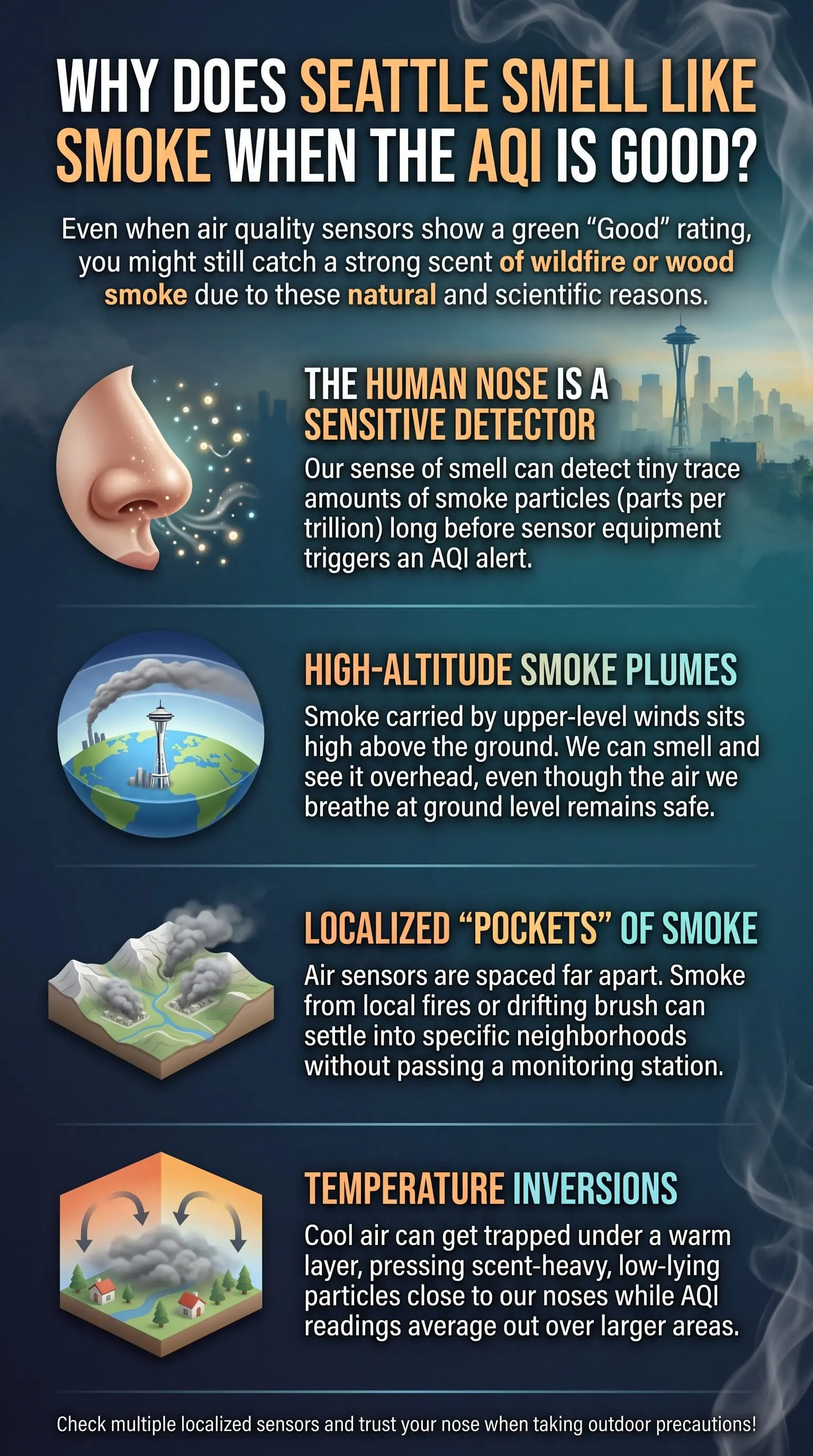
A Good Seattle AQI and a smoky smell can both be accurate, because they measure different things.
Wildfire smoke often travels overhead, so haze and smell can show up before ground monitors register it.
NowCast readings rise late and fall late when smoke moves fast.
From October through February, wood stoves under an inversion often explain neighborhood smoke.
Most smoke odor comes from gases the AQI skips, so particle filters cut the health risk and activated carbon handles the smell.
What the Seattle AQI Actually Measures
The air quality index is a health scale, not a smell detector. It rolls five pollutants into one number, covering ground-level ozone, particle pollution, carbon monoxide, sulfur dioxide, and nitrogen dioxide, and whichever one scores worst sets the headline reading.
Around Puget Sound on a smoky day, that headline almost always comes from PM2.5, fine particles small enough to settle deep in your lungs. Your nose is reading something else.
Four Reasons Your Nose Beats the Monitor
The Smoke Is Overhead, Not at Street Level
Smoke from fires in Oregon, eastern Washington, or British Columbia often rides into the region thousands of feet up. You see it as haze, or as a sunset that looks almost too orange. Ground monitors sample the air at breathing height, so they may barely register it.
By afternoon, the sun warms the ground and the air starts to churn. Pockets of that high smoke mix down to street level, and that's often when you catch the first whiff, well before enough smoke settles to move the regional number.
The Reading Is Running Behind
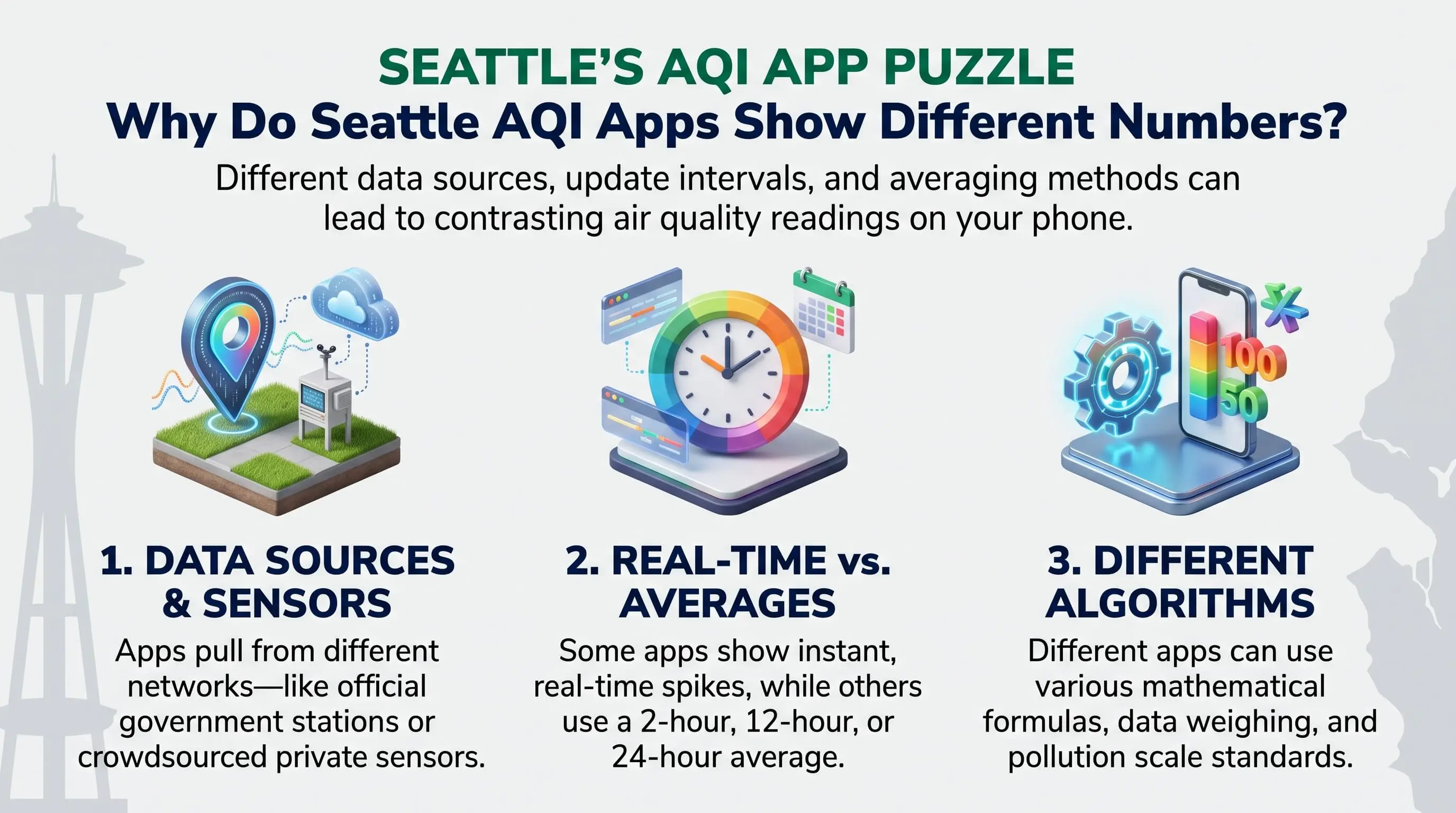
Most apps show a NowCast AQI. It's an EPA method that blends recent hourly readings into one current value, and it leans harder on the latest hours when air quality shifts fast. Even so, it trails a plume that rolls in quickly. The lag runs in reverse too, so the number can stay high for hours after the smoke clears out.
The Smoke Is Coming From Your Block
Plenty of smoky Seattle evenings have nothing to do with wildfire. From October through February, wood stoves and fireplaces are a leading source of fine particles around Puget Sound. On cold, still nights, a temperature inversion acts like a lid on a pot and holds that smoke close to the ground, right in the neighborhoods making it.
Your nearest regulatory monitor might sit miles away in a different pocket of air. One chimney upwind is enough to put smoke under your nose while the official reading stays clean.
You're Smelling Gases the Index Doesn't Count
Much of what you smell in smoke comes from volatile organic compounds, the gases wood and vegetation give off as they burn. The AQI leaves them out. Your nose catches them easily, so it can flag smoke while particle levels still read Good.
Is It Safe to Be Outside If You Smell Smoke?
For most healthy adults, a faint smell with a good reading is low risk. The smell confirms smoke is around, though it can't tell you how much.
Some people need more caution. Washington's Department of Health asks anyone with heart or lung disease, diabetes, or a respiratory infection to limit time outdoors once smoke reaches Moderate. Babies, children, adults over 65, and pregnant people should start watching for symptoms at that same level. Keep an eye out for:
Burning eyes, a runny nose, or a scratchy throat
Coughing or wheezing
Headache
Shortness of breath or chest tightness
If symptoms build, believe your body over the map and call your health care provider.
How to Tell Which Smoke You're Smelling
The calendar is a better clue than most people expect.
July through September: Probably regional wildfire smoke, often riding aloft. You'll notice the haze first and the smell later in the day.
October through February evenings: Probably chimney smoke pinned down by an inversion, strongest after dark and in the early morning.
Early July: Leftover fireworks smoke that usually clears by afternoon.
A sharp, chemical, or plastic smell at any time: Possibly a nearby structure or vehicle fire. Call 911 if you see flames or heavy smoke.
October gets tricky here because late fire smoke and early stove smoke overlap. Western Washington experienced a severe smoke episode in October 2022, so falling leaves don't mean the fire season is over. Keeping high quality filters in place helps reduce the smoke particles entering your home's air.
What to Do When Your Nose and the Seattle AQI Disagree
Check a closer sensor. The AirNow Fire and Smoke Map layers corrected low-cost sensors over the official monitors. The Puget Sound Clean Air Agency also runs a neighborhood sensor map covering King, Kitsap, Pierce, and Snohomish counties.
Look up burn ban status. When the Clean Air Agency has a burn ban in effect, local wood smoke is the likely source.
Close up and recirculate. Shut windows and doors, then set your system to recirculate so it stops pulling outdoor air inside.
Filter the particles. Run your HVAC fan with a MERV 13 filter, or the highest rating your system can handle. A HEPA portable air cleaner that doesn't produce ozone works too.
Handle the odor on its own. Particle filters let gases pass right through. If the smell hangs around indoors, activated carbon is the media made for that job.
Pro tip: Write down your filter size and rating now, so a smoky night doesn't turn into a hunt through the return vent.
Gaps around attic hatches, recessed lights, and rim joists let outside air and smoke slip in uninvited. Sealing and insulating those gaps cuts how much of it reaches your living space on burn ban nights. If the index itself is still new to you, this beginner's guide to reading air quality walks through the basics.
“Based on my experience, the smell beats the monitor by an hour or more on a fast-moving plume, because the reading is still averaging in the cleaner air from earlier while your nose samples what's here right now. When a homeowner tells me the house smells like a campfire on a green AQI day, I have them check the sensor closest to their street before they look at the citywide number.”
7 Essential Resources
AirNow Fire and Smoke Map FAQ: how the NowCast works and why the nearest monitor may not match what you see or smell.
Puget Sound Clean Air Agency Sensor Map: neighborhood particle readings across King, Kitsap, Pierce, and Snohomish counties.
Washington State Department of Health: Smoke From Fires: who faces higher risk and how to keep indoor air clean.
Washington State Department of Ecology: Wildfire Smoke: statewide maps, smoke forecasts, and a low-cost DIY filter guide.
Public Health Seattle and King County: Wildfire Smoke: local advice on masks, HEPA filters, and staying indoors.
CDC: Wildfires and Your Safety: what to do before, during, and after a smoke event.
NIEHS: Air Pollution and Your Health: the research on why fine particles and pollutant gases matter.
3 Statistics Worth Knowing
Seattle's short-term particle problem is measurable. State of the Air 2026 ranked the Seattle-Tacoma metro 8th worst in the nation for short-term particle pollution, with an average of 11.3 unhealthy days a year. American Lung Association
Winter smoke starts at home. Residential wood burning is a leading source of fine particles in Puget Sound during cold, stagnant weather. Puget Sound Vital Signs
Most of your exposure happens indoors. Americans spend about 90 percent of their time inside, where some pollutants run 2 to 5 times higher than typical outdoor levels. U.S. Environmental Protection Agency
Final Thoughts and Opinion
I'd trust the green number for planning and my nose for timing. The AQI is a well-built health tool, but it tracks particles across a whole region and can't tell you what's drifting past your porch this minute.
I also think Seattle underrates its winter smoke. Everyone remembers the orange summers. Far fewer people connect a cold, still December night with the same fine particles, coming from a few chimneys down the block instead of a fire 200 miles away. The dose is smaller. It repeats all season, though, right when everyone has the house shut tight.
So keep a sensor map bookmarked and treat the smell as a heads-up. A quick look at what the AQI numbers mean can help you tell when outdoor air is becoming unhealthy. You decide what your family breathes indoors, and a quick check is usually all it takes.
Frequently Asked Questions
Why can I smell smoke when the air quality is good?
Because the two track different things. Your nose picks up smoke gases the index doesn't count, the reading can lag a fresh plume, and the smoke may be overhead or drifting from a chimney no monitor sees.
What is smoke aloft?
It's wildfire smoke traveling high above the ground instead of at breathing height. It turns the sky hazy and the sunsets orange but often barely moves ground monitors. Afternoon warming can mix some of it down, so air quality sometimes slips later in the day. Proper insulation installation can help seal gaps in your home and reduce outdoor smoke infiltration.
How often does the Seattle AQI update?
Most official monitors report every hour, and apps show a NowCast value that gives the latest hours more weight. That beats a 24-hour average for speed but still lags a fast-moving plume.
Is it safe to exercise outside if I smell smoke?
For healthy adults who feel fine, light activity on a Good AQI day is usually reasonable. If you have asthma or a heart or lung condition, or you start coughing, wheezing, or getting a headache, take the workout indoors or wait for the smell to fade.
Does a HEPA filter remove smoke smell?
Not completely. HEPA media catches fine smoke particles very well, and those are the bigger health concern, especially if you're allergic to an air conditioner or sensitive to airborne irritants. The lingering odor comes mostly from gases that slip through, so activated carbon is what cuts the smell.
How do I check if there is a burn ban in Seattle?
The Puget Sound Clean Air Agency posts burn ban status for King, Kitsap, Pierce, and Snohomish counties. During a Stage 1 ban, you can't use fireplaces or uncertified wood stoves, and a violation can bring a $1,000 penalty.
Trust Your Nose and the Number
A smoky smell on a green AQI day means both signals are telling you something true about Seattle's air. Keep a neighborhood sensor map bookmarked and a fresh pleated furnace filter in place, and the next smoky evening can stay outside where it belongs.