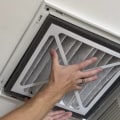
When choosing a 16x20x1 HVAC home air filter, those hidden differences matter more than most homeowners realize because they directly affect airflow, particle capture, and how well the filter performs over time in everyday residential use.
The 16x20x1 HVAC home air filter fits compact residential HVAC systems — manufactured homes, guest suites, smaller forced-air installations — and it’s one of the most commonly misjudged sizes when it comes to brand selection. The size is standardized across every manufacturer. What’s inside the frame is not. Two filters with the same MERV number from different brands can perform entirely differently by week six of a 90-day cycle, and nothing on the label will tell you that’s happening.
TL;DR Quick Answers
16x20x1 HVAC home air filter
The 16x20x1 is one of the most widely used filter sizes in compact residential HVAC systems — manufactured homes, guest suites, and smaller forced-air installations. Its nominal size is 16 inches wide by 20 inches tall by 1 inch deep; actual measured dimensions run approximately 15.5″ × 19.5″ × 0.75″. After manufacturing filters for over a decade, the 16x20x1 is also the size we see most often purchased at the wrong MERV rating for the household's actual conditions.
MERV rating guide for 16x20x1 filters:
MERV 8 — captures pollen, coarse dust, and mold spores; right for households without allergy or respiratory concerns
MERV 11 — minimum for homes with pets or mild allergy conditions; captures approximately 65% of particles in the 1–3 µm range where pet dander and mold spores concentrate
MERV 13 — highest standard residential filtration; captures 85% or more of fine particles in the 1–3 µm range; confirm your system can handle the additional airflow resistance before upgrading
What to look for on the label:
A tested MERV rating under ASHRAE Standard 52.2 — not a marketing claim without an independent result
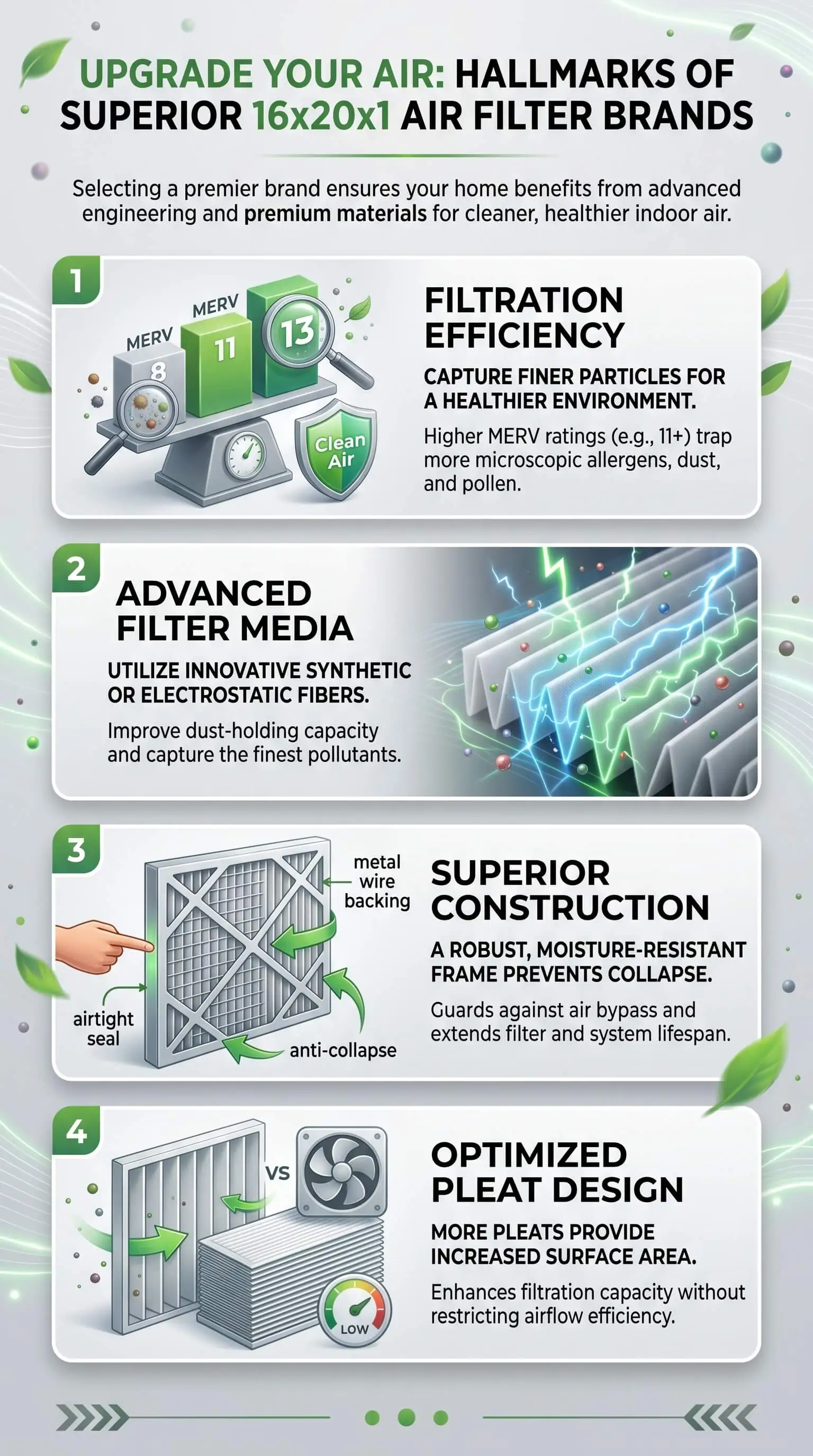
Pleated media with a stated pleat count — more pleats means more capture surface in a 1-inch frame
A stable frame (beverage board or wire-backed) that maintains its dimensional seal under sustained blower pressure
MERV-A rating if the media uses electrostatic charge — shows real-world conditioned performance, not first-day results
Replacement schedule:
Standard households: every 60–90 days
Homes with pets or allergy occupants: every 30–45 days
Monthly check: hold the filter up to a light source — if light doesn't pass through clearly, replace it regardless of the date
Browse 16x20x1 air filters sized, rated, and built to perform through a full service cycle.
Top Takeaways
The 16x20x1’s smaller surface area makes pleat count more consequential than in larger filter sizes — fewer pleats means less capture surface per square inch, faster loading, and earlier performance decline before the rated MERV is no longer being reached.
A MERV rating is only as reliable as the independent test behind it. Brands that submit to ASHRAE Standard 52.2 give you a verifiable result; the rest are giving you a printed claim.
A standard MERV 8 filter captures approximately 20 percent of particles in the 1–3 µm range where pet dander and mold spores fall. MERV 11 raises that to about 65 percent, and MERV 13 to 85 percent or better.
Frame material determines whether a filter holds its seal through the service cycle. Single-ply cardboard frames are the most likely to bow or warp under sustained system pressure in a return-air slot.
Electrostatic charge media tests well when new but degrades with use; a published MERV-A rating reflects conditioned, real-world performance rather than a first-day result from a fresh filter.
A filter that doesn’t seat flush in the 16x20x1 slot creates bypass air gaps — the MERV rating provides no protection for the airflow routing around the media rather than through it.
Replace a 16x20x1 filter every 60–90 days in standard conditions and every 30–45 days in homes with pets, allergy occupants, or higher occupancy, since the smaller format accumulates particles faster than larger sizes.
Why the 16x20x1 Is a Different Challenge Than Larger Filter Sizes
The 16x20x1’s actual measured dimensions run close to 15.5 by 19.5 by 0.75 inches. That’s a smaller physical footprint than the 20x25x1 — which puts less filter media in contact with the airstream and causes the filter to accumulate debris faster per square inch under the same household conditions.
Larger filters can get away with a modest pleat count because more total media compensates. In a 16x20x1, that buffer disappears. Fewer pleats means less capture surface, which means the filter loads faster and hits diminished performance earlier in the service cycle. Brands that compete on price often reduce pleat count first — it’s the least visible cost-cutting move on a finished product.
An air filter’s media surface area is what actually captures particles, not the MERV number on the frame. That number comes from a controlled test on a new, clean filter. Whether the filter still performs anywhere near that rating on day 45 of a 90-day cycle is a construction question, not a label question.
What MERV Testing Actually Tells You About a Brand
MERV ratings are established under ASHRAE Standard 52.2, which tests a filter’s particle capture efficiency across three size ranges: 0.3–1.0 µm, 1.0–3.0 µm, and 3.0–10.0 µm. A filter earns its rating based on worst-case performance across those ranges as it accumulates standardized test dust over a defined loading protocol.
That standardized test is the line between a credible brand and one working with marketing language. After manufacturing filters for over a decade and serving more than two million households, one gap keeps showing up: a filter advertising “MERV 11 performance” without an independent test result isn’t performing the same way as one submitted to the 52.2 protocol. You can’t see that difference on the packaging.
For a 16x20x1 household, MERV 8 handles basic dust control when no occupant has allergies or respiratory sensitivities. MERV 11 raises capture efficiency in the 1–3 µm range to approximately 65 percent — where pet dander and mold spores concentrate. MERV 13 reaches 85 percent or better in the same range. A MERV claim without a result tested under Standard 52.2 is a marketing number, and that distinction matters before you buy.
Frame Construction and Dimensional Accuracy: What Most Labels Don’t Disclose
A 16x20x1 filter that doesn’t seat flush in its return-air slot defeats its own MERV rating — air routes around the path of least resistance. If there’s a gap between the filter frame and the slot walls, a portion of every cubic foot of conditioned air bypasses the media entirely. The MERV on the packaging becomes irrelevant for that fraction of airflow.
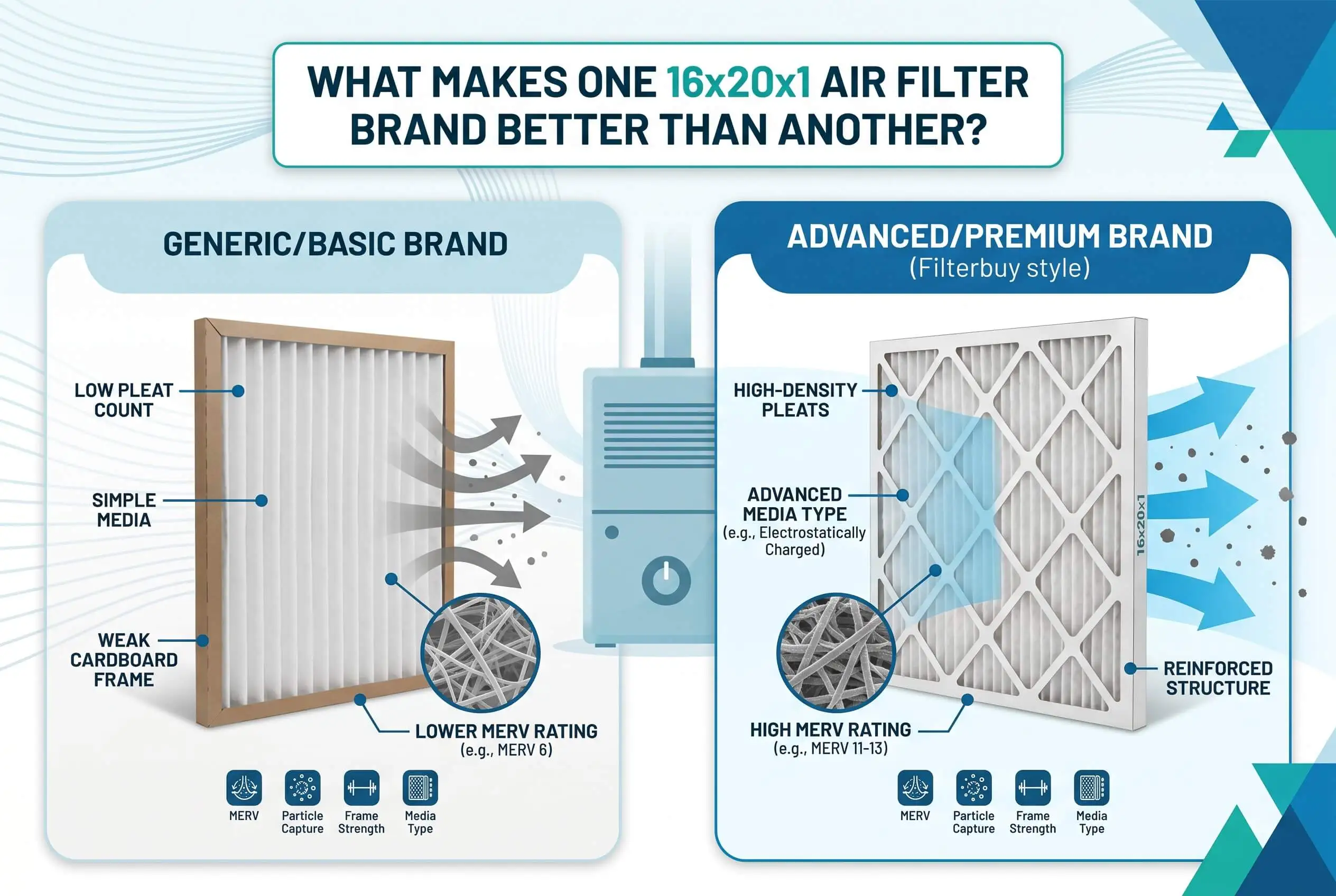
Frame material determines whether a filter holds its shape and seal through a full service cycle. Single-ply cardboard frames are the least expensive option and the most likely to bow or lose structural integrity under sustained system pressure. In a return-air slot where the blower pulls air continuously, a softening frame can lose contact with the slot walls weeks before your replacement window opens. Beverage board frames are denser and hold their shape better. Wire-backed frames maintain dimensional accuracy through conditions that defeat both.
Dimensional accuracy creates the same bypass problem from a different direction. The 16x20x1 nominal size should produce actual dimensions close to 15.5 by 19.5 inches. Brands that manufacture slightly undersized filters to simplify production create a built-in bypass gap that won’t appear on the label. The most common symptom is a filter that loads faster than expected, with the excess airflow bypassing the media rather than passing through it.
Media Quality and Pleat Count: The Number the Brand Doesn’t Always Print
Pleat count and media type are where brand quality becomes specific. More pleats within the same frame means more filtration surface area available to the airstream, which translates to better particle capture and slower loading per cubic foot of air. A quality brand publishes the pleat count. If a brand omits it, they’ve decided the buyer doesn’t need that information — which is a signal worth noticing.
Some brands use electrostatically charged media to achieve higher tested MERV ratings with less physical media. That works on a new filter. The charge degrades with use, and real-world performance drops below the rated MERV before the cycle is done. ASHRAE addresses this by defining MERV-A ratings, which measure efficiency on a filter that’s been conditioned to simulate actual use. A brand that publishes a MERV-A rating is showing you what happens after the filter has been in a real system for a while. Without that number, you’re looking at first-day performance — not what it delivers on day 60.
When comparing 16x20x1 filters, the packaging should confirm a MERV number tested under Standard 52.2, a stated pleat count, and — if the media carries an electrostatic charge — a MERV-A rating. A brand willing to print all three has something verifiable to say about how it’s built.
Replacement Schedule for a 16x20x1 — and Why Brand Matters There Too
Standard guidance puts the 16x20x1 replacement interval at 60 to 90 days. Because the 16x20x1 has less surface area than larger formats, it accumulates particles faster under the same household conditions. In homes with pets, allergy sufferers, or higher occupancy, 30 to 45 days is the right window.
A well-constructed filter — accurate pleat count, stable frame, quality media — holds its rated performance through the recommended cycle. One built to a lower construction standard won’t, and that difference usually shows up before the replacement window closes. A filter with a collapsing cardboard frame can lose its seal by the second month of a 90-day cycle. One with charged media and no MERV-A disclosure may drop below rated efficiency in the first. Either way, the household is paying for a MERV 11 and receiving something less with no visible sign of the drop.
The replacement schedule assumes the filter performs to its rated MERV for the full interval. Pull it out each month and hold it up to a light source. If light doesn’t pass through clearly, replace it now. Browse 16x20x1 air filters built to the construction standards that hold through the full recommended cycle.
“In a 16x20x1 format, the frame is doing as much work as the media. A filter that bows or loses its seal by week three allows bypass air regardless of its MERV rating, and we see this consistently with single-ply cardboard frames in standard return-air slots. A filter that holds its shape and dimensional contact through the full service cycle is worth more than a higher MERV number printed on a weaker frame.”
7 Essential Resources
The following sources come from federal agencies, established engineering organizations, and non-profit health groups. Each is cited for a specific reason relevant to filter construction quality and the indoor air outcomes it affects.
How Biological Contaminants Enter and Circulate Through Your Home’s Air System
The EPA details how biological pollutants including mold, pet dander, and dust mites enter and recirculate through residential HVAC systems through inadequately maintained equipment and contaminated air handling components. This resource connects filtration quality directly to real health outcomes and explains what happens when an underperforming filter lets those pollutants bypass the media.
Source: Biological Pollutants’ Impact on Indoor Air Quality — U.S. Environmental Protection Agency
ASHRAE’s MERV Standard: What Filter Testing Actually Measures
ASHRAE established and maintains the MERV testing standard (Standard 52.2) that all credible filter ratings are built on. This resource explains the three particle size ranges used in the test protocol, the difference between MERV and MERV-A ratings, and what filter efficiency data actually means in a real HVAC system. If you want to understand what’s behind any brand’s MERV claim, this is the primary source.
Source: Filtration and Disinfection FAQ — ASHRAE
Allergy Triggers and Indoor Allergen Exposure in the United States
The Asthma and Allergy Foundation of America publishes current data on allergy prevalence across the United States and identifies indoor allergens — pet dander, dust mites, and mold spores — as the most common year-round triggers. This resource provides the scale of the indoor allergen problem that filter brand quality directly addresses for the tens of millions of households managing ongoing allergy symptoms.
Source: Allergy Facts — Asthma and Allergy Foundation of America
Indoor Air Pollutants: What Makes the Air Inside a Home Unhealthy
The American Lung Association’s resource on indoor air pollutants identifies the sources — biological contaminants, combustion byproducts, VOCs, and outdoor pollutants that enter the home — and explains why air filtration is one of the three core strategies for managing indoor air quality alongside source control and ventilation. It grounds why what the filter media captures has real health consequences.
Source: Indoor Air Pollutants — American Lung Association
What NIEHS Research Has Found About Indoor Allergens and Asthma Severity
The National Institute of Environmental Health Sciences summarizes its funded research on indoor allergens most commonly linked to asthma severity and allergy symptoms, including dust mites, cockroaches, and pet dander. This resource provides the scientific context for why filter capture efficiency in the 1–3 µm particle range — where these allergen particles concentrate — directly affects household health outcomes and helps explain what makes the best filter for pet dander effective.
Source: Dust Mites and Cockroaches — National Institute of Environmental Health Sciences
CDC Guidance on Asthma and the Indoor Triggers That Drive It
The Centers for Disease Control and Prevention’s asthma resource covers the indoor environmental triggers — dust mites, pet dander, mold, cockroach allergens — that make asthma harder to manage. For households where a 16x20x1 filter is the primary line of defense against those triggers, the CDC’s guidance on reducing indoor allergen exposure connects directly to what the filter needs to capture.
Source: Asthma — Centers for Disease Control and Prevention
Indoor Allergies: What Allergists Say About Environmental Control
The American College of Allergy, Asthma, and Immunology covers the full landscape of indoor allergen triggers and the environmental control strategies — including air filtration — that allergists recommend for reducing exposure. This resource connects clinical recommendations to the household decisions that filter brand selection represents.
Source: Indoor Allergies — American College of Allergy, Asthma, and Immunology
Supporting Statistics
These numbers come from federal agencies and established research. They confirm what the households we’ve served have shown us about what’s at stake in filter selection.
Americans Spend 90 Percent of Their Time Indoors — Where Indoor Pollutant Levels Run 2 to 5 Times Higher Than Outdoors
The EPA reports that Americans spend approximately 90 percent of their time indoors, where concentrations of some pollutants are often 2 to 5 times higher than typical outdoor levels. Those most susceptible to poor indoor air — children, older adults, and people with respiratory or cardiovascular conditions — tend to spend even more time inside. For every home where a 16x20x1 filter sits in the return-air slot, the quality of that filter, along with insulation, shapes what circulates through 90 percent of the household’s day. A filter that allows bypass air or drops below its rated MERV mid-cycle is recirculating the particles a properly constructed filter would have caught.
Source: Indoor Air Quality — EPA’s Report on the Environment, U.S. Environmental Protection Agency
A Standard MERV 8 Filter Captures Only About 20 Percent of Particles in the 1–3 Micron Range
ASHRAE’s filtration guidance documents that a typical MERV 8 filter is only about 20 percent efficient at capturing particles in the 1 µm to 3 µm size range — where pet dander, mold spores, and fine dust particles concentrate. A MERV 11 raises that to approximately 65 percent. A MERV 13 reaches 85 percent or better in the same range. Those figures assume the filter performs to its rated MERV throughout the service cycle. When the frame bows, the media loses charge, or bypass air develops around a poorly seated filter, the effective capture rate drops below those benchmarks. The MERV on the label is a ceiling, and only a well-constructed filter consistently reaches it.
Source: Filtration and Disinfection FAQ (PDF) — ASHRAE
Approximately 81 Million People in the United States Were Diagnosed With Allergic Rhinitis in 2021
The Asthma and Allergy Foundation of America reports that approximately 81 million people in the U.S. — around 26 percent of adults and 19 percent of children — were diagnosed with seasonal allergic rhinitis in 2021. Indoor allergens including pet dander, dust mite waste, and mold spores are among the most common year-round triggers for those same individuals. For the tens of millions of households managing ongoing allergy symptoms, the gap between a 16x20x1 filter that holds its rated MERV through a full service cycle and one that drops below it mid-cycle is measured in daily allergen exposure for occupants who are already sensitive.
Source: Allergy Facts and Figures — Asthma and Allergy Foundation of America
Final Thoughts and Opinion
A 16x20x1 air filter brand earns its reputation in a running system, not on a shelf. The filter that holds its frame seal, sustains its pleat count’s performance, and stays at or near its rated MERV through a full 60-to-90-day cycle is the better brand — regardless of how the front of the packaging is written.
For the homeowner who takes maintaining the home seriously — the one who checks the filter each month rather than waiting for the reminder — this question has a real answer. A filter that loses its seal or drops below rated efficiency at week three is failing quietly, with no visible sign of the change, while the household keeps breathing air the MERV label promised would be cleaner. The frame looks fine on the outside. So does the MERV number on the packaging. And the household has no way of knowing the filter stopped performing to that rating weeks ago.
The right 16x20x1 HVAC home air filter brand is the one whose construction backs up its label — an independently tested MERV, a frame that holds its dimensional seal, a disclosed pleat count, and a MERV-A rating if the media carries an electrostatic charge. That’s the standard worth holding any brand to.
Frequently Asked Questions
Q: What makes one 16x20x1 air filter brand better than another?
A: Three construction factors separate quality brands from cheaper alternatives:
Pleat count: more pleats means more media surface area, better particle capture, and slower loading relative to a lower-pleat filter at the same MERV rating
Frame material and dimensional accuracy: a filter that bows or seats loosely creates bypass gaps that the MERV rating can’t account for
Tested vs. marketed MERV: a brand that submits to ASHRAE Standard 52.2 independent testing provides a verifiable performance result; a brand using marketing language without that standard provides a claim
Q: Is a higher MERV rating always better in a 16x20x1 filter?
A: Not always. A higher MERV creates more airflow resistance, and in older or lower-capacity systems, the added pressure from a MERV 13 can reduce airflow enough to strain the unit. MERV 11 is a solid default for most households with pets or mild allergy concerns. MERV 13 is appropriate for households with significant allergy or asthma conditions and systems that can handle the additional pressure drop. MERV 8 is adequate for basic dust control in households without those concerns. If you’re unsure what your system can handle, check the manufacturer’s documentation or ask your HVAC technician.
Q: What does pleat count mean for a 16x20x1 air filter?
A: Pleat count is the number of folds in the filter media within the frame. More pleats mean more surface area available to capture particles. In a 16x20x1 — physically smaller than most common residential filter sizes — pleat count has a more pronounced effect on performance. A filter with 20 pleats and one with 14 pleats at the same MERV rating won’t perform equally over a full service cycle. A brand that publishes the pleat count gives you a number you can use to compare. A brand that omits it has made a decision about what you don’t need to know.
Q: How do I know if a 16x20x1 filter fits my HVAC system correctly?
A: The nominal size (16x20x1) should match the labeled dimensions of your return-air slot. Actual measured dimensions are typically approximately 15.5” × 19.5” × 0.75” — slightly smaller to allow the filter to slide in without forcing. What matters is that the filter seats flush against all four edges with no visible gaps. Hold a flashlight to the slot after installing: if light passes around the filter frame, air is bypassing the media. A brand that maintains tight dimensional tolerances and publishes its actual dimensions makes this easier to verify before you install.
Q: How often should I replace a 16x20x1 air filter?
A: Every 60–90 days for standard households without significant allergen or respiratory concerns. Every 30–45 days for homes with pets, allergy occupants, or higher occupancy. The 16x20x1’s smaller surface area accumulates particles faster per square inch than larger formats under the same conditions. Check the filter monthly by holding it up to a light source — if light doesn’t pass through clearly, replace it now regardless of the scheduled date.
Q: What is the actual size of a 16x20x1 air filter?
A: The nominal dimensions are 16 inches wide by 20 inches tall by 1 inch deep. Actual measured dimensions are approximately 15.5” × 19.5” × 0.75”, which is standard and allows the filter to slide into a slot labeled 16x20x1 without a forced fit. If you’re replacing an existing filter, check the actual size printed on its current frame before ordering to confirm the match.
Q: Does a cheaper 16x20x1 filter protect my HVAC system as well as a premium brand?
A: Not across a full service cycle. A lower-cost filter may test at an equivalent MERV when new. The difference shows up in construction: single-ply cardboard frames that bow under sustained pressure, lower pleat counts that cause faster loading, and charged media that degrades below rated MERV before the cycle ends. A filter that holds its rated MERV for 90 days delivers more protection than one that performs at that level for 30 days and then quietly drops off. The HVAC system runs fine either way. The difference shows up in what’s recirculating through the household’s air.
The Filter Brand Evaluation Starts With the Label
Knowing what to look for on the packaging makes the selection straightforward. Look for a tested MERV under Standard 52.2, a stated pleat count, and dimensions that seat flush in the return-air slot — the marks of a brand with nothing to hide about how it’s built.
Browse 16x20x1 air filters manufactured to the construction standards that perform through a full service cycle, not just the first few weeks of one.