After completing insulation projects across Seminole County, we've learned that cost and condition are inseparable. A home sitting at R-11 with moisture-damaged insulation requires a different scope than a home that needs a straightforward top-up to R-49. The difference between those two projects can be thousands of dollars — and the only way to know which one you're facing is to measure what's actually there before anyone quotes you a number.
This page covers what attic insulation projects actually cost in Altamonte Springs by project type, material, and home profile. It covers the incentives that can reduce that investment by up to $2,000. And it covers the step most homeowners skip that determines whether the project delivers what it promises — or underperforms from the first cooling season forward, helping homeowners choose top insulation installation near Altamonte Springs FL for better comfort and long-term energy savings.
TL;DR Quick Answers
Top Insulation Installation Near Altamonte Springs FL
Here's what every Altamonte Springs homeowner needs to know before requesting a single quote on an attic insulation project:
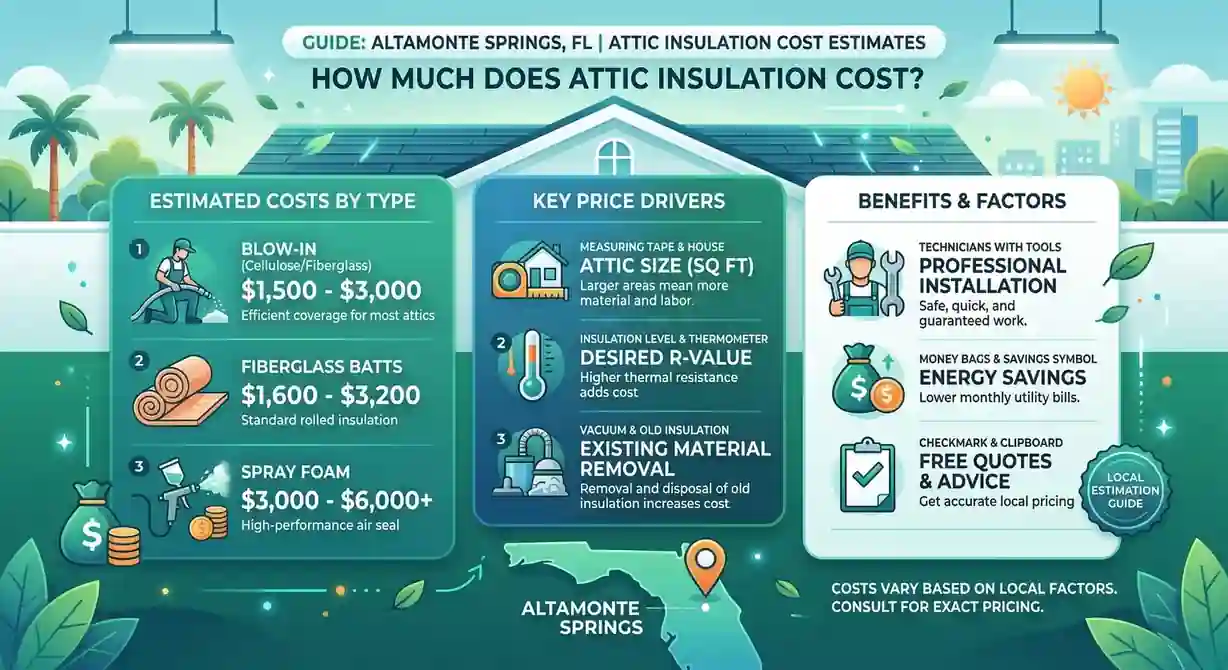
Cost ranges by project type: Top-up only: $800 – $1,500. Full replacement with air sealing: $1,500 – $4,000. Spray foam applications: $2,000 – $5,000+. No quote is accurate without measuring what's actually in the attic first.
Target R-value: R-49 to R-60 — not the R-38 code minimum. Florida's heat, humidity, and compression-driven performance loss demand more.
Best material: Blown-in fiberglass for most Altamonte Springs attics. Closed-cell spray foam for homes with moisture history, attic duct systems, or significant air leakage.
Available incentives: Up to $2,000 combined — Duke Energy Florida rebate (up to $800) plus Federal 25C tax credit (30%, up to $1,200). Complete the Duke Energy Home Energy Check before installation begins or both incentives are forfeited.
Air sealing comes first. Insulation installed over unsealed leaks delivers a fraction of its potential. The lowest quote almost always leaves this step out — and the bill reflects it every month until someone finishes the job correctly.
The return on investment is real. EPA estimates 15% average savings on heating and cooling costs. DOE puts average annual weatherization savings at $372 or more. Florida's 40% above-average electricity costs mean the payback compounds faster here than almost anywhere else.
The scope determines the cost — not the other way around. Any contractor who quotes a number without measuring existing R-value and assessing insulation condition is estimating. In Altamonte Springs' climate, that's a risk the utility bill pays for.
Who to call: Filterbuy HVAC Solutions serves Altamonte Springs and surrounding Seminole County communities including ZIP codes 32701, 32714, 32716, and 32751.
Top Takeaways
The lowest quote is rarely the lowest cost. Skip air sealing. Skip measuring R-value. Skip permits. The savings don't materialize. The bill stays elevated. Someone has to come back and finish the job correctly.
Scope determines cost — not the other way around. A home at R-11 with moisture damage is a different project than a straightforward top-up to R-49. The only way to know which one you're facing is to measure what's in the attic before anyone quotes a number.
The upfront cost and the operating cost are two different conversations. Compressed insulation at half its rated R-value is already costing money every month. A properly completed project. Up to $2,000 in available incentives. $372 or more in annual savings. The math changes entirely.
The sequence matters as much as the project. Duke Energy Home Energy Check must come before installation. Federal 25C eligibility must be confirmed before work begins. Get the order wrong and up to $2,000 in incentives is lost before the first bag of insulation is opened.
The attic determines what every other energy investment delivers. A high-efficiency AC unit in a home with degraded insulation will still underperform. The attic isn't one upgrade among many. It's the upgrade that makes every other upgrade work.
What Attic Insulation Projects Actually Cost in Altamonte Springs — By Project Type
Not every attic insulation project is the same scope. After completing projects across Seminole County, these are the ranges we see most consistently:
Top-up only (existing insulation in good condition, below target R-value):
Typical range: $800 – $1,500
Best for: Post-1990 homes with structurally sound insulation below R-38
Full replacement with air sealing (degraded, compressed, or moisture-damaged insulation):
Typical range: $1,500 – $4,000
Best for: Pre-2000 homes, homes with moisture history, or any home where R-value hasn't been assessed in over a decade
Spray foam applications (significant air leakage, attic duct systems, or moisture intrusion history):
Typical range: $2,000 – $5,000+
Best for: Homes requiring maximum air sealing performance or closed-cell moisture barriers
One thing we tell every homeowner upfront: the scope determines the cost — not the other way around. Quotes generated without measuring existing R-value and assessing insulation conditions are estimates built on assumptions. In Altamonte Springs' climate, a professional attic insulation installation service begins with proper measurement and evaluation to ensure the project is accurate, effective, and delivers lasting comfort and energy efficiency.
What Drives the Cost Difference in Altamonte Springs Attic Projects
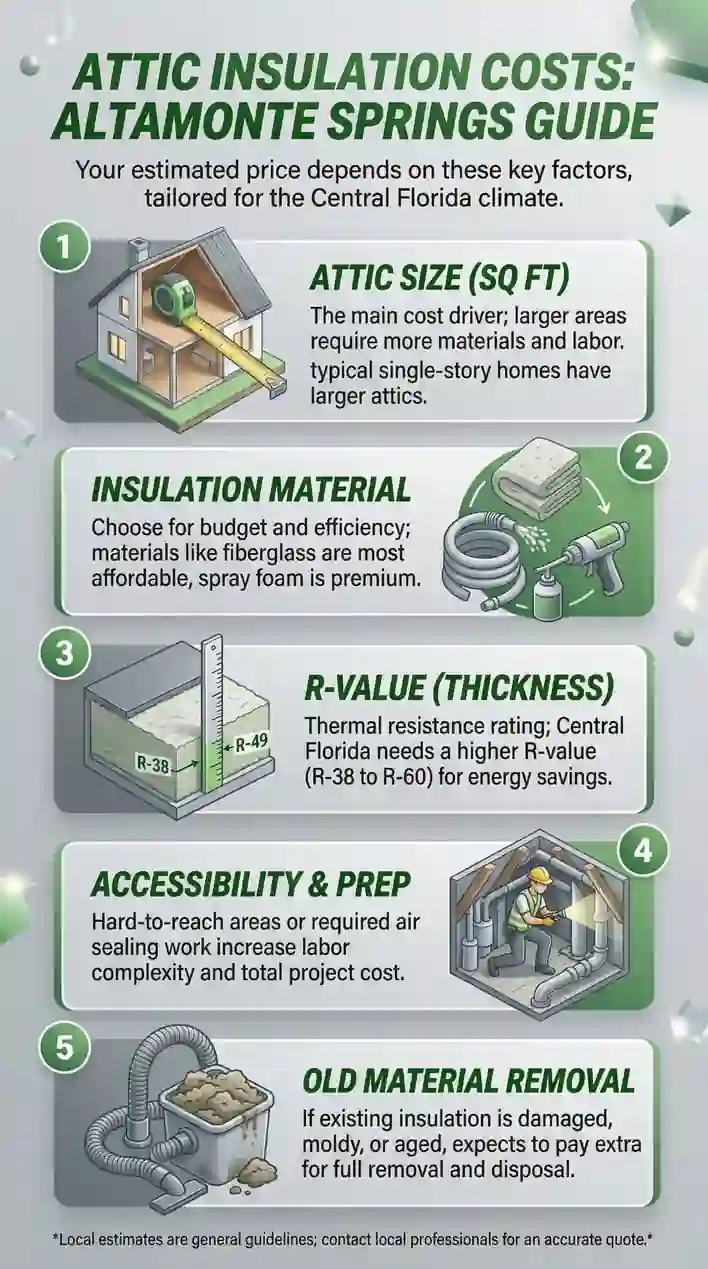
Two homes in the same Seminole County ZIP code can have dramatically different project costs. Here's what actually moves the number:
Current insulation condition:
Compressed or moisture-damaged insulation requires full removal before new material goes in
Removal adds labor time and disposal costs that a top-up project doesn't carry
Pest contamination requires remediation before any insulation work can begin
Existing R-value:
A home at R-19 needs significantly more material to reach R-49 than a home at R-30
Homes with duct systems in the attic benefit from higher target R-values — R-60 in most cases — which increases material volume and cost
Attic configuration:
Irregular attic floors, low clearance, and significant obstruction increase labor time
Homes with multiple HVAC penetrations require more extensive air sealing before installation
Air sealing scope:
The number and severity of unsealed penetrations — recessed lights, duct boots, attic hatches — directly affects labor hours
Skipping air sealing reduces upfront cost but undermines the entire project's performance
Size of the home:
Larger attic footprints require more material and more installation time
Altamonte Springs homes in the 1,500 – 2,500 square foot range represent the most common project profile we work with
How to Reduce Your Attic Insulation Cost by Up to $2,000 in Altamonte Springs
The financial case for attic insulation in Altamonte Springs is stronger right now than it's been in years. Two incentive programs can be combined — but only if the steps are completed in the correct order.
Duke Energy Florida Attic Insulation Rebate:
Up to $800 for qualifying projects
The Duke Energy Home Energy Check must be completed before installation begins — not after
Homeowners who complete installation first forfeit the rebate entirely
Federal 25C Energy Efficient Home Improvement Tax Credit:
30% of qualifying project cost, up to $1,200
Eligibility and documentation must be confirmed before work is done
Cannot be applied retroactively after installation is complete
Combined maximum offset: up to $2,000. On a $2,500 full replacement project, that's 80% of the cost recovered through incentives alone — before utility savings are factored in. We've worked with homeowners who lost both incentives by getting the sequence wrong. The order of operations is non-negotiable.
Why the Cheapest Quote in Altamonte Springs Usually Costs More in the Long Run
We hear this regularly. A homeowner received three quotes. Ours wasn't the lowest. They want to understand the difference.
Here's what the lowest quote almost always leaves out:
Air sealing — the step that determines whether insulation performs at its rated R-value or underperforms from day one
Permit pulling — required for code-compliant work in Seminole County; skipping it means no accountability to the 2023 Florida Building Code standard
Existing R-value measurement — without it, there's no honest baseline and no way to verify the outcome
Incentive documentation — the paperwork required for Duke Energy rebate and federal tax credit eligibility doesn't complete itself
In Altamonte Springs' climate, an insulation project that skips air sealing will reflect that gap on every utility bill from May through October. The savings the project was supposed to deliver don't materialize. The equipment keeps running harder than it should. And eventually, someone has to come back and finish what the first contractor left incomplete.
The lowest quote covers installation. A complete quote covers the outcome.
What a Complete Attic Insulation Project Delivers — Beyond the Upfront Cost
The project cost is one number. The return on that investment is a different conversation entirely.
What homeowners in Altamonte Springs consistently report after a properly completed attic insulation project:
The AC cycles off during peak afternoon heat for the first time in years
Rooms that were previously warmer than the rest of the house reach consistent temperatures
The utility bill drops — in some cases significantly — on the first full billing cycle after completion
The equipment runs less, extends its service life, and requires less maintenance
The numbers that frame the return:
EPA estimates 15% average savings on heating and cooling costs through attic insulation and air sealing
Florida homes spend 40% more on electricity than the national average
A home with inadequate insulation runs utility bills 10% or more above a well-insulated comparable home
On a $250/month electricity bill, a 15% reduction is $37.50 per month — $450 per year. Combined with up to $2,000 in available incentives, a properly completed attic insulation project in Altamonte Springs pays for itself in a timeframe that makes the decision straightforward for most homeowners who take the time to run the numbers.
"We can't tell you what an attic insulation project will cost until we know what's actually up there. We've quoted jobs that looked like simple top-ups from the outside and turned into full replacements the moment we opened the hatch. Compressed insulation. Moisture damage. R-values that hadn't met code in years. The homeowners who focus exclusively on the lowest upfront number almost always spend more in the end — because the project that skipped air sealing and skipped measuring existing conditions didn't deliver what it promised. The bill stayed high. The AC kept running hard. A properly completed attic insulation project in Altamonte Springs isn't just an upfront cost. It's the number that stops compounding against you every cooling season going forward."
Essential Resources
We share these resources with every homeowner we sit down with before a single number gets discussed. Understanding what a complete project involves — and what you're entitled to recover through incentives — changes every conversation that comes after.
1. Know What a Complete Project Should Look Like Before Anyone Quotes You: ENERGY STAR Attic Insulation Project Guide
Most homeowners we talk to have never seen a properly scoped attic insulation project laid out from start to finish. This ENERGY STAR guide covers exactly what a complete job involves — what conditions require professional attention before work begins, and what every step from air sealing through final R-value documentation should include. Know this before you accept any quote.
https://www.energystar.gov/saveathome/seal_insulate/attic-insulation-project
2. Know Your R-Value Target Before the First Contractor Gives You a Number: ENERGY STAR Recommended Home Insulation R-Values
Altamonte Springs sits in Climate Zone 2. This is the reference we use on every assessment we complete in Seminole County. Knowing the recommended R-value for your specific climate before anyone walks through your door means every proposal can be evaluated against an objective standard — not just compared against the other quotes on the table.
3. Measure What You Have Before Committing to Any Cost: ENERGY STAR How to Check Your Home's Attic Insulation Level
The scope of your project — and therefore the cost — depends entirely on what's already in your attic. This guide shows you how to measure your existing R-value before a contractor arrives. It's the step that turns a general estimate into a project grounded in what's actually there.
https://www.energystar.gov/products/ask-the-experts/how-check-your-homes-attic-insulation-level
4. Understand Why Air Sealing Is Part of the Cost — Not an Optional Line Item: ENERGY STAR Attic Air Sealing Project Guide
New insulation installed over unsealed air leaks is the most common reason attic projects underperform — and the most common thing we find in Altamonte Springs homes that received a lower quote from someone else. This guide identifies the leak points we encounter most often in Florida homes and explains why air sealing has to come before insulation. A quote that leaves it out isn't saving you money. It's shifting the cost to your utility bill.
https://www.energystar.gov/saveathome/seal_insulate/attic-air-sealing-project
5. Get an Objective Baseline Before Any Dollar Is Committed: DOE Guide to Home Energy Assessments
A professional home energy assessment gives you a measured, independent baseline for your attic's current performance before installation begins. In Altamonte Springs, it's also the step that unlocks the Duke Energy rebate program — making it one of the most valuable first steps available, and one of the most consistently skipped.
https://www.energy.gov/energysaver/home-energy-assessments
6. Cut Up to $800 Off Your Project Cost — But Only If You Do This Before Installation: Duke Energy Florida Attic Insulation Rebate
Duke Energy Florida offers up to $800 on qualifying projects for Altamonte Springs homeowners. The Home Energy Check must be completed before installation begins — not after. We've watched homeowners lose this rebate and the federal tax credit in the same project by getting the sequence wrong. The savings are real. The order of operations is non-negotiable.
https://www.duke-energy.com/home/products/home-energy-improvement/attic-insulation-upgrade?jur=FL01
7. Get 30% Back on Your Project — But Read the Requirements Before Work Begins: IRS Section 25C Energy Efficient Home Improvement Credit
Qualifying attic insulation projects are eligible for 30% back — up to $1,200. Most homeowners we work with find out about this credit after the project is already done. The eligibility requirements and documentation process cannot be completed after installation. This is the resource to read first — before you schedule the work, not after you receive the invoice.
https://www.irs.gov/credits-deductions/energy-efficient-home-improvement-credit
These resources outline the importance of insulation services by explaining proper attic project standards, recommended R-values for Climate Zone 2, essential air sealing practices, and the rebates and tax credits that help homeowners complete insulation upgrades correctly while improving energy efficiency and reducing long-term cooling costs.
Supporting Statistics
We reference these numbers when a homeowner asks whether a properly scoped attic insulation project is worth the investment. The data and the field experience point to the same answer every time.
Compressed insulation will not provide its full rated R-value — and in Florida's climate, that performance gap costs money every month.
The U.S. Department of Energy is direct on this point: compressed insulation will not deliver its full rated R-value. What the data doesn't capture — but what we see consistently in Altamonte Springs attics — is how invisible that performance gap actually is.
What compression-driven performance loss looks like in the field:
A home originally insulated to R-30 may be performing at R-15 or lower after years of Florida heat and humidity
Nothing looks wrong from the hatch — the insulation is still physically present
The AC compensates by running longer. The bill climbs. Nobody investigates because there's no visible warning sign.
In pre-2000 Seminole County homes, compression-driven performance loss is the single most consistent driver of full replacement projects we complete — and the most consistently overlooked cause of elevated utility bills we encounter.
Source: U.S. Department of Energy — Insulation https://www.energy.gov/energysaver/insulation
Weatherization improvements — including attic insulation — save households an average of $372 or more every year according to a national DOE evaluation.
The U.S. Department of Energy's Weatherization Assistance Program national evaluation puts average annual savings from weatherization improvements at $372 or more per household. We reference this figure because it reframes the cost conversation entirely.
The math most Altamonte Springs homeowners haven't run:
A $2,500 full replacement project generating $372 in annual savings pays for itself in under 7 years
That timeline shortens significantly when up to $2,000 in combined Duke Energy and federal tax credits are applied
Florida's 40% above-average electricity costs mean annual savings often exceed the national benchmark
The homeowners who push back hardest on project cost are almost always the ones who haven't yet run those numbers.
Source: U.S. Department of Energy — Weatherization Assistance Program https://www.energy.gov/scep/wap/weatherization-assistance-program
EPA's 15% average savings estimate for attic insulation and air sealing is corroborated by over 20 years of field data from professional contractors.
ENERGY STAR's methodology documentation confirms that EPA's 15% average savings estimate isn't just modeled — it's backed by more than 20 years of real-world field experience from professional building science contractors. That context matters because it reflects the same work we do in Altamonte Springs attics every week.
What 15% actually means for a Florida household:
At $250/month in electricity: $37 – $45 in monthly savings — $450 or more annually
At $300/month during peak summer months: savings climb higher
Combined with up to $2,000 in available incentives, the payback timeline becomes straightforward on paper
The 15% figure isn't theoretical. It's the accumulated result of thousands of completed projects across every climate zone in the country.
Source: ENERGY STAR — Methodology for Estimated Energy Savings https://www.energystar.gov/saveathome/seal_insulate/methodology
9 out of 10 U.S. homes are under-insulated — meaning most Altamonte Springs homeowners are already paying the cost of inadequate insulation without knowing it.
ENERGY STAR's finding that 9 in 10 U.S. homes are under-insulated holds up against every attic we've opened in Seminole County. What the statistic doesn't convey is the specific financial weight under-insulation carries in Florida.
Why under-insulation hits harder in Altamonte Springs than almost anywhere else:
AC already consumes 28% of total household energy in Florida
Annual electricity expenditures run 40% above the national average
Under-insulation compounds that cost — quietly, consistently, with no single moment that connects the bill to the cause
The homeowners most resistant to project cost are often the ones who don't yet realize they've already been paying for it. Not in one visible transaction. In hundreds of slightly elevated utility bills over years — with no single moment that connected the cost to the cause.
Source: ENERGY STAR — Why Seal and Insulate? https://www.energystar.gov/saveathome/seal_insulate/why-seal-and-insulate
These statistics demonstrate how professional attic insulation installation helps restore proper R-values, reduce energy loss caused by compression and air leakage, and deliver measurable savings on cooling costs, especially in climates where long AC runtimes amplify the impact of under-insulated attics.
Final Thought & Opinion
After completing attic insulation projects across Altamonte Springs and Seminole County, one observation shapes every cost conversation we have. Homeowners who focus exclusively on the upfront number almost always end up spending more — not because the project was overpriced, but because the project they chose was incomplete.
The pattern we see most consistently:
A homeowner accepts the lowest quote
Air sealing is excluded — or the existing R-value was never measured
Insulation goes in over unsealed leaks and unaddressed compression damage
The bill improves modestly, if at all
Six months later, someone calls to ask why the project didn't deliver what was promised
The answer is almost always the same. The project covered installation. It didn't cover the outcome.
Our opinion, formed after years of completing and assessing attic projects in this market: the cost of a properly scoped attic insulation project isn't the most important number in the conversation. The most important number is what the home costs to operate before the project — and what it costs after.
What the data and our field experience consistently show:
Compressed insulation performing at half its rated R-value is already costing the homeowner money every month
A $2,500 project generating $372 in annual savings pays for itself in under 7 years — before incentives
Up to $2,000 in combined incentives is available now — but only for homeowners who follow the correct sequence
Florida's 40% above-average electricity costs mean the return compounds faster here than almost anywhere else
The homeowners who come away most satisfied aren't the ones who found the lowest price. They're the ones who searched for an attic insulation installation near me, understood what a complete project actually costs, and invested in a solution that delivers lasting comfort and energy savings over time.
FAQ on Top Insulation Installation Near Altamonte Springs FL
Q: How much does attic insulation installation cost in Altamonte Springs FL?
A: It depends on what's actually in the attic. Any quote generated without measuring existing conditions is an estimate built on assumptions. In Altamonte Springs' climate, those assumptions are rarely accurate.
Typical project ranges based on what we find in Seminole County attics:
Top-up only: $800 – $1,500
Full replacement with air sealing: $1,500 – $4,000
Spray foam applications: $2,000 – $5,000+
What moves the number most:
Insulation condition — compression and moisture damage require full removal before new material goes in
Existing R-value — a home at R-11 needs significantly more material to reach R-49 than a home at R-30
Air sealing scope — unsealed penetrations add labor hours a top-up project doesn't carry
Attic configuration — irregular floors and low clearance increase installation time
We've quoted projects that looked like straightforward top-ups and turned into full replacements the moment we opened the hatch. The scope determines the cost — not the other way around.
When homeowners evaluate upgrades, the article How Much Does Attic Insulation Cost in Altamonte Springs FL? explains that the total investment depends on factors such as attic size, existing insulation levels, material type, and whether air sealing is required before installation. Improving attic insulation reduces heat transfer, which can lower cooling costs and help HVAC systems run more efficiently. Alongside insulation improvements, maintaining proper airflow and filtration also supports system performance. Using reliable filters like the 18x18x1 pleated furnace air filter helps capture dust and airborne particles that circulate through the system. Standard replacement options such as the 16x20x1 MERV 8 HVAC air filter further support consistent airflow and cleaner indoor air while insulation upgrades improve thermal efficiency. For homeowners comparing additional filtration options, the MERV 11 HVAC replacement air filter illustrates another compatible choice that works alongside attic insulation improvements to help keep cooling costs controlled and indoor comfort more consistent year-round.