The answer most homeowners need: change your filter every 20 to 45 days — not the standard 60 to 90. But in our experience, the right interval depends on factors specific to your home, and a one-size schedule leaves real gaps in protection.
This page breaks down the filter change frequency that asthma-sensitive households actually need, the MERV rating that makes the biggest difference, and the household variables — pets, home size, local air quality — that may require you to act even sooner.
TL;DR Quick Answers
Air Filter Replacement
Air filter replacement is the process of removing a used HVAC filter and installing a fresh one to maintain clean indoor air circulation. How often you replace it — and which filter you use — determines how much protection your home's air system actually provides.
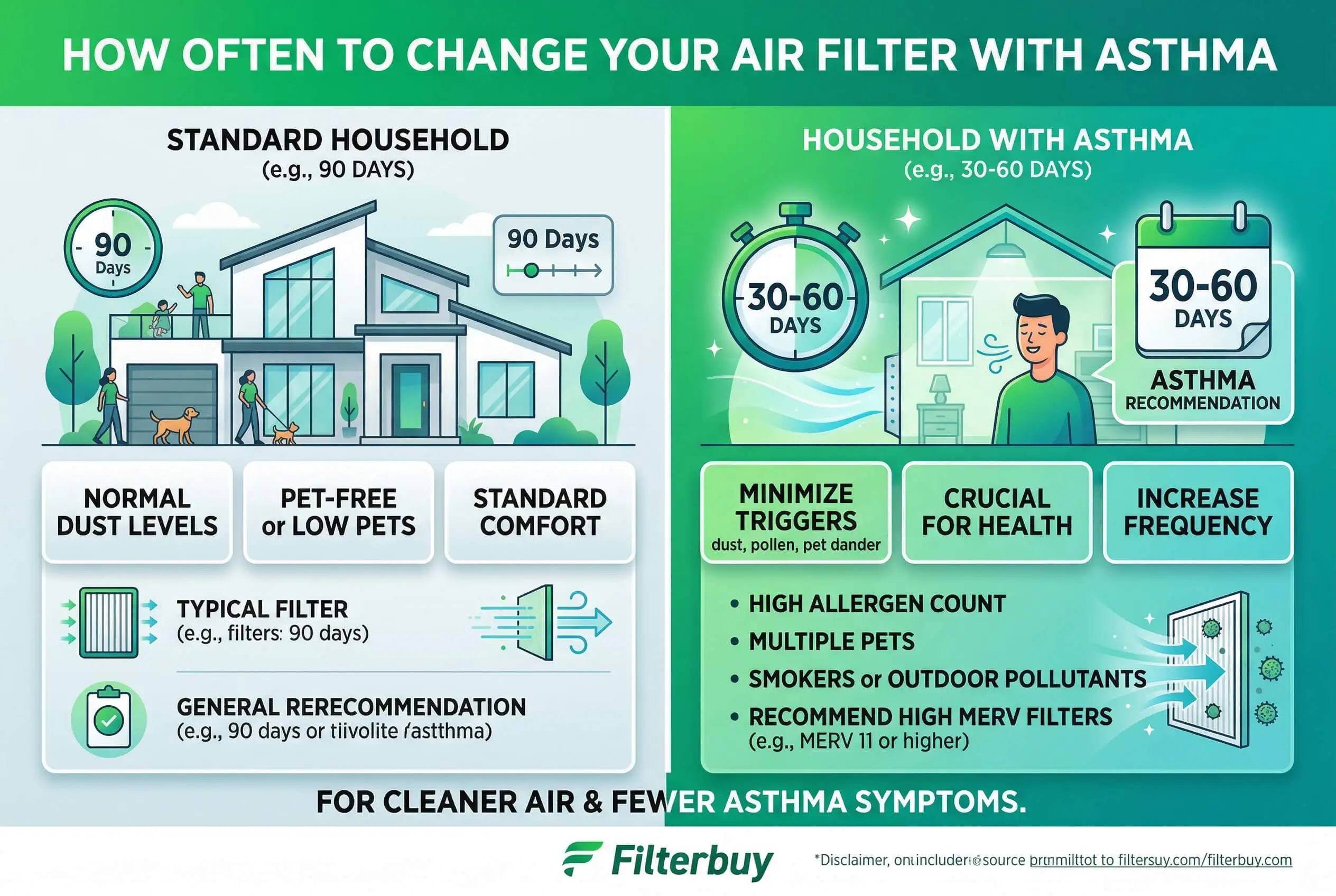
Replacement frequency by household type:
Average household, no sensitivities: every 60 to 90 days
Household with allergies: every 45 to 60 days
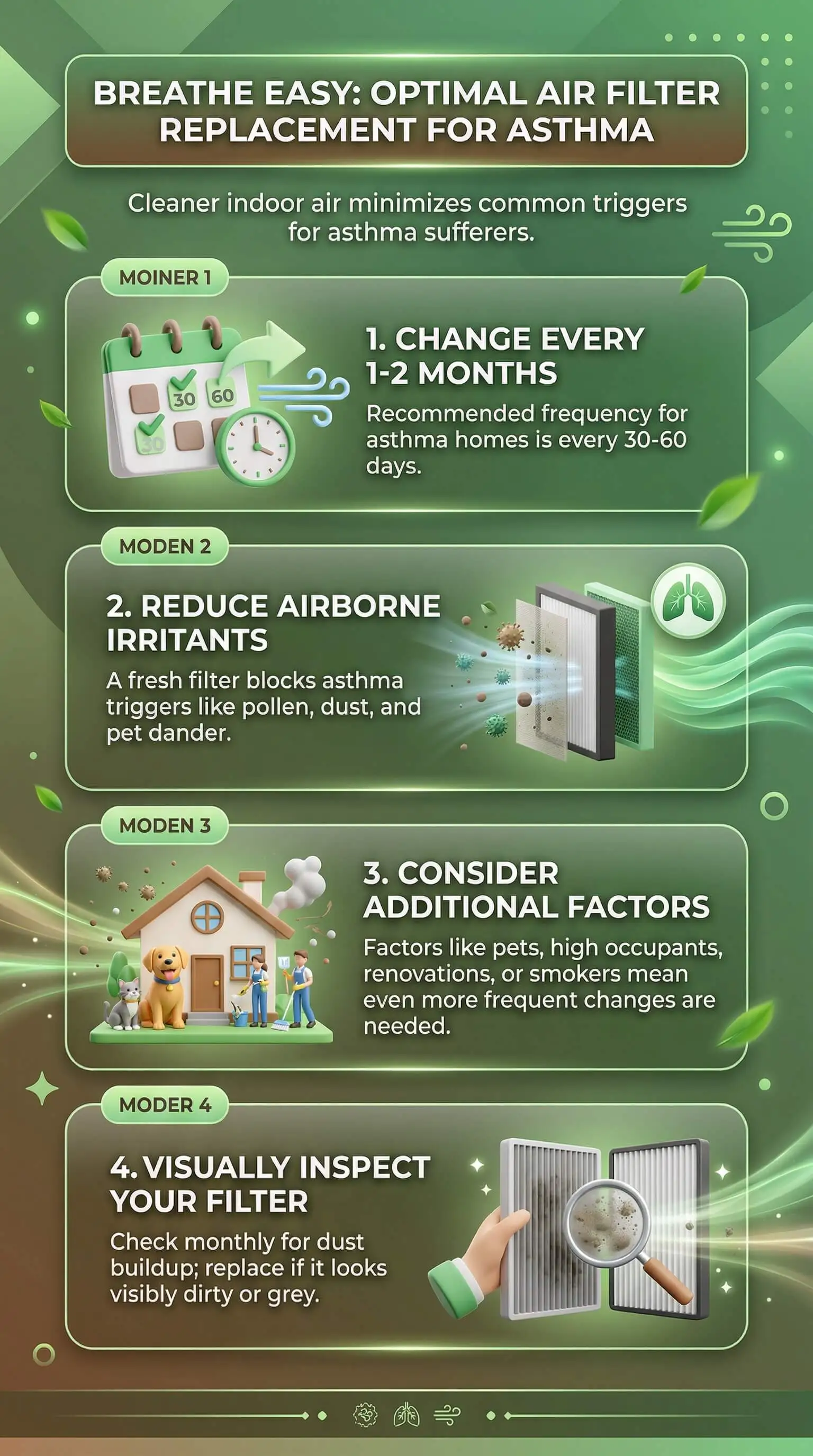
Household with asthma: every 20 to 45 days
Household with asthma and pets: every 20 to 30 days
Household with asthma, multiple pets, or multiple sufferers: every 20 to 25 days
Recommended MERV ratings by household need:
Standard household: MERV 8
Allergy-sensitive household: MERV 11
Asthma-sensitive household: MERV 11 minimum, MERV 13 preferred
Signs your filter needs immediate replacement:
Gray or brown discoloration across the filter face
Reduced airflow from supply vents
Increased dust on furniture near registers
Musty odor from vents when the system runs
Respiratory symptoms that worsen at home but improve when away
Key insight from over a decade of manufacturing and two million households served: filter freshness matters more than filter rating. A high-rated filter that is overdue offers less real-world protection than a lower-rated filter changed consistently and on time.
Top Takeaways
Change your filter every 20 to 45 days — not the standard 60 to 90. Standard intervals were never designed for asthma-sensitive households. Your exact schedule depends on pets, home size, number of asthma sufferers, and local air quality.
Filter freshness matters more than filter rating. A MERV 13 that is overdue offers less real-world protection than a MERV 11 changed on time. Frequency and rating work together — neither compensates for a failure in the other.
MERV 11 is the minimum for asthma households — MERV 13 is the preferred standard. Filters below MERV 11 miss the fine particles most linked to asthma triggers: dust mite debris, mold spores, pet dander, and fine particulate matter in the 1–3 micron range.
A clogged filter doesn't just stop filtering — it starts shedding. Captured particles dislodge and re-enter circulation. If symptoms worsen at home but improve when away, an overdue filter is the first variable to investigate.
The home environment is the one asthma variable families control completely. Asthma is uncontrolled in approximately 50% of children and 62% of adults who have it — even under medical care. Consistent air filtration is one of the most evidence-backed and actionable interventions available.
Why Standard Filter Change Advice Doesn't Apply to Asthma Households
Most filter change guidance is written for the average home — no pets, no smokers, no respiratory sensitivities, and a standard 1-inch filter running a typical cycle. In our experience manufacturing filters for over a decade and working with millions of households, the families who follow standard 60- to 90-day recommendations in asthma-sensitive homes are the ones most likely to call us frustrated with recurring symptoms and unexplained flare-ups.
The reason is straightforward: a filter loaded with captured particulates doesn't just stop filtering — it begins shedding. As airflow forces its way through a clogged filter media, trapped particles can dislodge and re-enter circulation. For someone with asthma, those recirculating particles — dust mite debris, mold spores, pollen fragments, and fine particulate matter — are precisely what triggers an attack.
Standard advice treats filter changes as an HVAC maintenance task. For asthma households, it's a health intervention.
The Right Filter Change Frequency When Someone Has Asthma
The baseline recommendation for homes with an asthma sufferer is every 20 to 45 days. That range exists because no two households are identical, and several variables tighten or widen that window. Use this as your starting framework:
No pets, one asthma sufferer: Change every 30 to 45 days
One pet, one asthma sufferer: Change every 20 to 30 days
Multiple pets or multiple asthma sufferers: Change every 20 to 25 days
Asthma sufferer who is a child or elderly: Prioritize the shorter end of any applicable range
When in doubt, err toward changing sooner. A fresh filter costs far less than a missed dose of prevention.
The MERV Rating That Makes the Biggest Difference
Filter change frequency solves half the problem. Filter efficiency solves the other half. After serving more than two million households, we consistently recommend MERV 11 as the minimum for asthma-sensitive homes, with MERV 13 as the preferred choice wherever the HVAC system supports it.
Here is why that distinction matters:
MERV 8 captures larger debris but misses the fine particles — dust mite allergens, mold fragments, and particles in the 1–3 micron range — most associated with asthma triggers
MERV 11 captures particles down to 1 micron, providing meaningful protection against common asthma triggers without restricting airflow in most residential systems
MERV 13 captures particles as small as 0.3 microns, including fine combustion particles and airborne biological material, making it the strongest residential option for high-sensitivity households
One important note: upgrading to a MERV 13 filter in a system designed for lower ratings can restrict airflow and strain the blower motor. If you are unsure whether your system supports MERV 13, check your HVAC manual or measure the static pressure across the filter housing.
Household Variables That Require a Shorter Change Interval
Beyond the baseline schedule, certain conditions in your home compress the effective lifespan of any filter. In our experience, these are the variables that most commonly push asthma households toward the shorter end of the 20-to-45-day range:
Pets: Pet dander is one of the most potent asthma triggers and one of the fastest filter-loading agents. Even a single dog or cat can cut filter lifespan nearly in half.
High-traffic periods: More people in the home means more skin cells, tracked-in particles, and increased airflow cycles — all of which accelerate filter loading.
Local air quality: Homes in areas with elevated AQI readings, proximity to highways, or during wildfire season accumulate outdoor particulates rapidly, compressing your change window significantly.
Recent renovation or construction: Drywall dust, wood particles, and adhesive fumes load a filter within days during and after home improvement projects. Change your filter immediately after any significant renovation work.
Older homes: Ductwork in older construction often carries accumulated dust, debris, and mold fragments that a new filter catches quickly and completely.
Warning Signs Your Filter Is Already Overdue
A calendar reminder is useful, but the filter itself will show you when it has hit its limit. Watch for these signals:
Visible gray or brown discoloration across the entire filter face
Reduced airflow from supply vents — rooms that used to cool or heat quickly now lag
Increased dust accumulation on furniture, especially near supply registers
Worsening asthma symptoms at home that improve when the household member is away
A musty or stale odor from the vents when the system runs
That last signal — symptoms improving when away from home — is one of the clearest indicators we hear about from asthma families. If the filter is overdue and the system has been running, those particles have already been redistributed throughout the home. Change the filter, run the system for a full cycle, and vacuum all supply and return registers before resuming normal use.
How to Build a Filter Change Schedule That Actually Holds
The most common reason asthma households miss filter changes isn't neglect — it's the absence of a system. Here is what works consistently:
Set a recurring calendar reminder at the midpoint of your target interval. If your household calls for a 30-day change, set reminders at days 15 and 30 — the first to check, the second to replace.
Keep two to three replacement filters on hand at all times. Running out of stock is the single most common cause of delayed changes.
Subscribe to auto-delivery. Having filters arrive on your chosen schedule removes the decision entirely and ensures you are never caught without a replacement.
Inspect at every change. Note the color and loading pattern of the old filter — a filter that loads heavily toward the center indicates strong airflow but high particulate volume. A filter loaded heavily along the edges suggests a poor seal around the frame, which means unfiltered air is bypassing the media entirely.
Protecting a household member with asthma starts with understanding that the air circulating through your home is only as clean as the filter catching what's in it. A consistent change schedule, the right MERV rating, and awareness of your household's specific variables are the three levers that make the biggest difference — and all three are fully within your control.
"Most homeowners with asthma in the family are doing everything right — except for one thing. They're following filter change advice that was never written with them in mind. After manufacturing filters for over a decade and working with more than two million households, what we've learned is this: the families who struggle most with indoor asthma triggers aren't using the wrong filter — they're changing it on the wrong schedule. A MERV 13 filter that's 60 days overdue offers less real-world protection than a MERV 11 changed on time, every time. Consistency and frequency matter more than the filter itself. That's not a marketing position — it's what the data from our customers actually shows."
Essential Resources
After manufacturing filters for over a decade and serving more than two million households — including countless families managing asthma every day — we've learned that the homeowners who make the biggest impact on their indoor air quality aren't just changing their filters more often. They're arming themselves with the right knowledge. Don't take your indoor air for granted. The pollutants triggering asthma attacks in your home are invisible, but the science behind stopping them isn't complicated once you know where to look. We've curated the seven most authoritative federal resources available so you can make every filter change count.
The EPA's Complete Guide to Air Cleaners: Know What Your Filter Is Actually Doing
Most homeowners have no idea how much performance separates a MERV 8 filter from a MERV 13 — or why that gap matters enormously in an asthma household. In our experience, this EPA guide is the single most useful starting point for any family trying to understand what their HVAC filter is capturing, what it's missing, and how to choose the right one. Read it before you buy your next filter. https://www.epa.gov/indoor-air-quality-iaq/guide-air-cleaners-home
The EPA on Asthma and Indoor Air: Why MERV 13 Is the Federal Recommendation for Sensitive Homes
We didn't arrive at our MERV 13 recommendation alone — the EPA gets there too. This resource identifies the exact indoor triggers that a properly rated filter must intercept: mold spores, dust mite debris, combustion byproducts, and chemical irritants that recirculate silently through your home every time your HVAC system runs. If someone in your household has asthma, this is required reading. https://www.epa.gov/indoorairplus/indoor-airplus-and-asthma
The EPA on Indoor Particulate Matter: See What Your Filter Is Up Against Every Single Day
One of the most important things we've learned from serving millions of households is this: most families underestimate how many different particle sources are actively loading their filter. This EPA resource makes the invisible visible — cataloging every major indoor particulate source linked to asthma triggers and explaining precisely why upgrading your filter and tightening your change schedule are two of the highest-impact actions you can take to protect your family's air. https://www.epa.gov/indoor-air-quality-iaq/sources-indoor-particulate-matter-pm
The CDC on Controlling Asthma: The Household Variables That Determine How Fast Your Filter Loads
You're the hero of your household when it comes to protecting your family's air — and that means understanding what your filter is fighting room by room. The CDC's asthma control resource covers the specific household variables — pet dander, mold, humidity, and dust mites — that directly determine how quickly your filter reaches its limit and when it needs to be replaced. Use this alongside your change schedule, not instead of it. https://www.cdc.gov/asthma/control/index.html
The CDC's Home Asthma Trigger Checklist: Audit Your Home the Way a Professional Would
After over a decade of working with asthma-sensitive households, we know that filter changes solve part of the problem — but a home that hasn't been audited for trigger sources will reload a fresh filter faster than necessary. This CDC checklist walks you through a room-by-room assessment of the most common hidden asthma triggers so you can address the sources, not just the symptoms. It's one of the most underused tools available to asthma families, and it costs nothing to use. https://www.cdc.gov/asthma/media/pdfs/2024/06/home_assess_checklist_P.pdf
The NHLBI on Asthma Causes and Triggers: The Science Behind Why Indoor Air Management Matters
Understanding why indoor allergens cause airway inflammation — not just that they do — is what separates reactive asthma management from proactive asthma protection. The National Heart, Lung, and Blood Institute's reference on asthma triggers connects indoor allergens, humidity, and particulate matter directly to the biological chain reaction that causes an attack. That connection is exactly why we frame consistent filtration as a health intervention, not a household chore. https://www.nhlbi.nih.gov/health/asthma/causes
The NHLBI 2020 Asthma Management Guidelines: The National Standard That Backs Every Recommendation on This Page
Everything we recommend about filter change frequency, MERV ratings, and household trigger management is grounded in the same evidence base that informs these guidelines. The NHLBI's 2020 updated national standards for asthma care specifically include reducing indoor trigger exposure — including air filtration — as a recommended component of a comprehensive management plan. When you follow the guidance on this page, you're not following a filter company's opinion. You're following science. https://www.nhlbi.nih.gov/health-topics/asthma-management-guidelines-2020-updates
Supporting Statistics
We don't ask asthma households to take our word for it. The federal data below makes the case — and it reinforces exactly why filter change frequency is one of the highest-impact actions you can take to protect your family's air.
Over 28 Million Americans Currently Have Asthma — About 1 in Every 12 People
Asthma is one of the most widespread chronic diseases in the United States. The scale is larger than most homeowners realize:
Over 28 million Americans currently have asthma
More than 4.5 million of those are children
That equals approximately 1 in every 12 people in the U.S.
After manufacturing filters for over a decade, we've seen firsthand that families who treat filter changes as a health priority — not a maintenance task — give asthma sufferers the best chance of breathing easier at home, where they spend the vast majority of their time.
Source: Asthma and Allergy Foundation of America — Asthma Facts and Figures (April 2025) https://aafa.org/asthma/asthma-facts/
Americans Spend About 90% of Their Time Indoors — Where Indoor Pollutants Run 2 to 5 Times Higher Than Outside
This is the EPA statistic that most homeowners find genuinely surprising. The air inside your home is frequently far more polluted than the air outside it. What that means for asthma households:
Indoor pollutant concentrations run 2 to 5 times higher than typical outdoor levels
Asthma sufferers spend the overwhelming majority of their time in that environment
An overloaded or under-rated filter isn't a minor inconvenience — it's a daily exposure risk
The home should be the safest air environment a family member with asthma encounters. With the right filter, proper insulation, and the right schedule, it can be.
Source: U.S. Environmental Protection Agency — Indoor Air Quality https://www.epa.gov/report-environment/indoor-air-quality
Asthma Is Uncontrolled in Approximately 50% of Children and 62% of Adults Who Have It
This is the statistic we find most striking — and most actionable. According to CDC research published in 2024:
Asthma remains uncontrolled in roughly 1 in 2 children who have it
Nearly 2 in 3 adults with asthma are not experiencing adequate symptom management
This is true even among those already receiving medical care
Indoor trigger reduction — including consistent, properly scheduled air filtration — is one of the most evidence-backed environmental interventions available. Changing your filter on the right schedule, with the right MERV rating, is one of the few variables you control completely.
Source: Centers for Disease Control and Prevention — The Status of Asthma in the United States, Preventing Chronic Disease (2024) https://www.cdc.gov/pcd/issues/2024/24_0005.htm
Asthma Sends 1.4 Million Americans to the Emergency Department Every Year
Emergency department visits represent the failure point of trigger management. The CDC reports 1.4 million ED visits annually with asthma as the primary diagnosis. Most are preceded by weeks of accumulating indoor trigger exposure. The highest-risk periods we see across asthma households consistently include:
Peak pollen season, when outdoor allergens infiltrate the home
Wildfire smoke events, which drive fine particulate levels indoors rapidly
Winter months, when sealed homes recirculate air — and everything in it — continuously
Serving over two million households has shown us that families who hold to a consistent filter change schedule through these periods are the ones most likely to stay out of that statistic.
Source: Centers for Disease Control and Prevention — FastStats: Asthma https://www.cdc.gov/nchs/fastats/asthma.htm
Final Thoughts
After manufacturing filters for over a decade and working with more than two million households, we've arrived at a conclusion the data supports but that rarely gets said directly: most asthma households are using the right product on the wrong schedule.
The filter industry defaults to a 60-to-90-day change interval because it works for the average home. Asthma households aren't average homes. In our experience, the difference between a family that manages asthma effectively indoors and one that cycles through recurring flare-ups often comes down to one variable: how often the filter gets changed.
What that means in practice:
A MERV 13 filter changed every 20 days will outperform a MERV 13 filter changed every 90 days in every meaningful measure
Filter rating matters — but filter freshness matters more than most homeowners are told
Families who struggle most with indoor triggers aren't failing at treatment — they're operating on a schedule that was never designed for their household
What the statistics confirm but general guidance misses:
Asthma is uncontrolled in the majority of people who have it, even under medical care. That's not a failure of medicine alone. It's a signal that the home environment — the one variable families control completely — deserves far more attention than a quarterly filter swap.
What we've observed across millions of households:
Customers who contact us frustrated by recurring symptoms are almost always changing their filter on a standard schedule
Symptoms improve consistently when change frequency is shortened and MERV rating is raised to match household sensitivity
The families with the best outcomes treat filter changes as a health decision — not a calendar reminder
Every home is different. Every asthma sufferer's triggers are different. But one principle holds across all of them: a clean filter, changed consistently, is one of the most cost-effective and controllable protections available to any household managing asthma.
You already made the right call by researching this. Adjusting your change schedule, confirming your MERV rating, and building a routine that removes the decision entirely — that's what moves the needle.
FAQ on Air Filter Replacement
Q: How often should you change your air filter if someone in your home has asthma?
A: Change your air filter every 20 to 45 days — not the standard 60 to 90 days recommended for average households. The right interval depends on your household's specific variables:
No pets, one asthma sufferer: every 30 to 45 days
One pet, one asthma sufferer: every 20 to 30 days
Multiple pets or multiple asthma sufferers: every 20 to 25 days
Child or elderly asthma sufferer: always use the shorter end of any applicable range
Filter change frequency is the single most underestimated variable in managing indoor asthma triggers. The right schedule matters as much as the right filter.
Q: What MERV rating is best for a home with an asthma sufferer?
A: MERV 11 is the minimum for asthma-sensitive households. MERV 13 is the preferred standard where the HVAC system supports it.
MERV 8 and below miss the fine particles most linked to asthma triggers — dust mite allergens, mold fragments, and particles in the 1–3 micron range
MERV 11 captures particles down to 1 micron without restricting airflow in most residential systems
MERV 13 captures particles as small as 0.3 microns, including fine combustion particles and airborne biological material
Important: Upgrading to MERV 13 in a system designed for lower ratings can restrict airflow and strain the blower motor. Check your HVAC manual or consult a technician before upgrading.
Q: What are the most common signs that an air filter is overdue for replacement in an asthma household?
A: Watch for these warning signs before your calendar reminder triggers:
Visible gray or brown discoloration across the entire filter face
Reduced airflow from supply vents — rooms that once heated or cooled quickly now lag
Increased dust accumulation on furniture near supply registers
Musty or stale odor from vents when the system runs
Asthma symptoms that worsen at home but improve when away
That last signal is the most telling. If symptoms improve outside the home but return indoors, an overloaded filter is the first variable to investigate. Change the filter, run a full system cycle, and vacuum all supply and return registers.
Q: Do pets affect how often you should change your air filter in an asthma household?
A: Yes — significantly. Pet dander is one of the most potent asthma triggers and one of the fastest filter-loading agents. Even a single dog or cat can cut a filter's effective lifespan nearly in half.
One pet: change every 20 to 30 days
Multiple pets: change every 20 to 25 days
Heavy-shedding breeds: change toward the shorter end of any applicable range
Pet dander distributes through ductwork quickly. Keeping filters fresh is the most effective ongoing defense — more so than any single deep-cleaning intervention.
Q: Can changing your air filter more frequently actually reduce asthma attacks at home?
A: Yes — when done correctly. The EPA, CDC, and NHLBI all identify indoor allergen reduction, including air filtration, as a recommended component of asthma management. Three conditions must be met for filtration to be effective:
The filter must be rated MERV 11 or higher to capture the particles most associated with asthma triggers
The filter must be changed before it reaches capacity — an overloaded filter sheds captured particles back into circulation
Filtration works best alongside broader trigger reduction — humidity control, pet management, and regular cleaning
Filtration does not replace medical management. A clean, properly rated filter change consistently removes a meaningful volume of the airborne particles that trigger attacks — making it one of the most controllable and cost-effective interventions available to any asthma household.
Ready to Build an Air Filter Schedule That Actually Protects Your Asthma Household?
Changing your filter on the right schedule — with the right MERV rating for your household's specific needs — is one of the most powerful steps you can take to reduce indoor asthma triggers where your family spends 90% of their time. Shop Filterbuy's full range of MERV 8, MERV 11, and MERV 13 filters, find your size, and set up an auto-delivery schedule that ensures you never miss a change.