TL;DR Quick Answers
20x20x1 air filter
A 20x20x1 air filter is a 1-inch nominal-size HVAC filter that drops into the return-air grille of most residential furnaces and AC systems. Actual dimensions run 19.5 by 19.5 by 0.75 inches. The MERV rating you pick (MERV 8, 11, or 13) decides what particles it captures and how often you replace it.
Actual size: 19.5 x 19.5 x 0.75 inches — the "20x20x1" you see on the box is the nominal listing size HVAC equipment is built around
MERV options: MERV 8 for standard households, MERV 11 for allergy and pet households, MERV 13 as the residential ceiling for fine particles
Replacement cadence: Every 90 days under baseline conditions, or every 30 to 60 days with pets, smokers, recent renovation, or visible mold in the home
What each MERV captures: Dust and lint at MERV 8, pollen and pet dander at MERV 11, smoke and most bacteria at MERV 13
Top Takeaways
A 20x20x1 air filter does capture mold spores, and effectiveness scales sharply by MERV rating. MERV 11 and MERV 13 are the residential options worth considering when spores are a concern.
Most common indoor mold spores fall in the 2 to 10 micron range. That is exactly where the ASHRAE 52.2 test method measures filter performance.
When a mold problem is active or suspected, shorten the 1-inch filter cadence from 90 days to 30 to 60 days. Watch the filter face for visible discoloration or a musty odor as the swap signal.
Filtration cannot fix a moisture source. EPA guidance is direct: mold control is moisture control, and indoor relative humidity belongs below 50 percent.
If mold is suspected inside the HVAC system itself, do not run the system. Running it spreads spores throughout the building. Shut it down and get an inspection before resuming.
What Mold Spores Actually Are (And How Big They Are)
Mold spores are reproductive units, not the mold itself. They are how mold colonies spread, and they ride through every cubic foot of indoor and outdoor air, around the clock. The EPA puts it bluntly: nobody can eliminate every spore from a home. The practical goal is keeping the count low enough that spores don't germinate, and quality insulation installation helps support that goal by improving moisture control, reducing condensation risks, and helping protect indoor air quality.
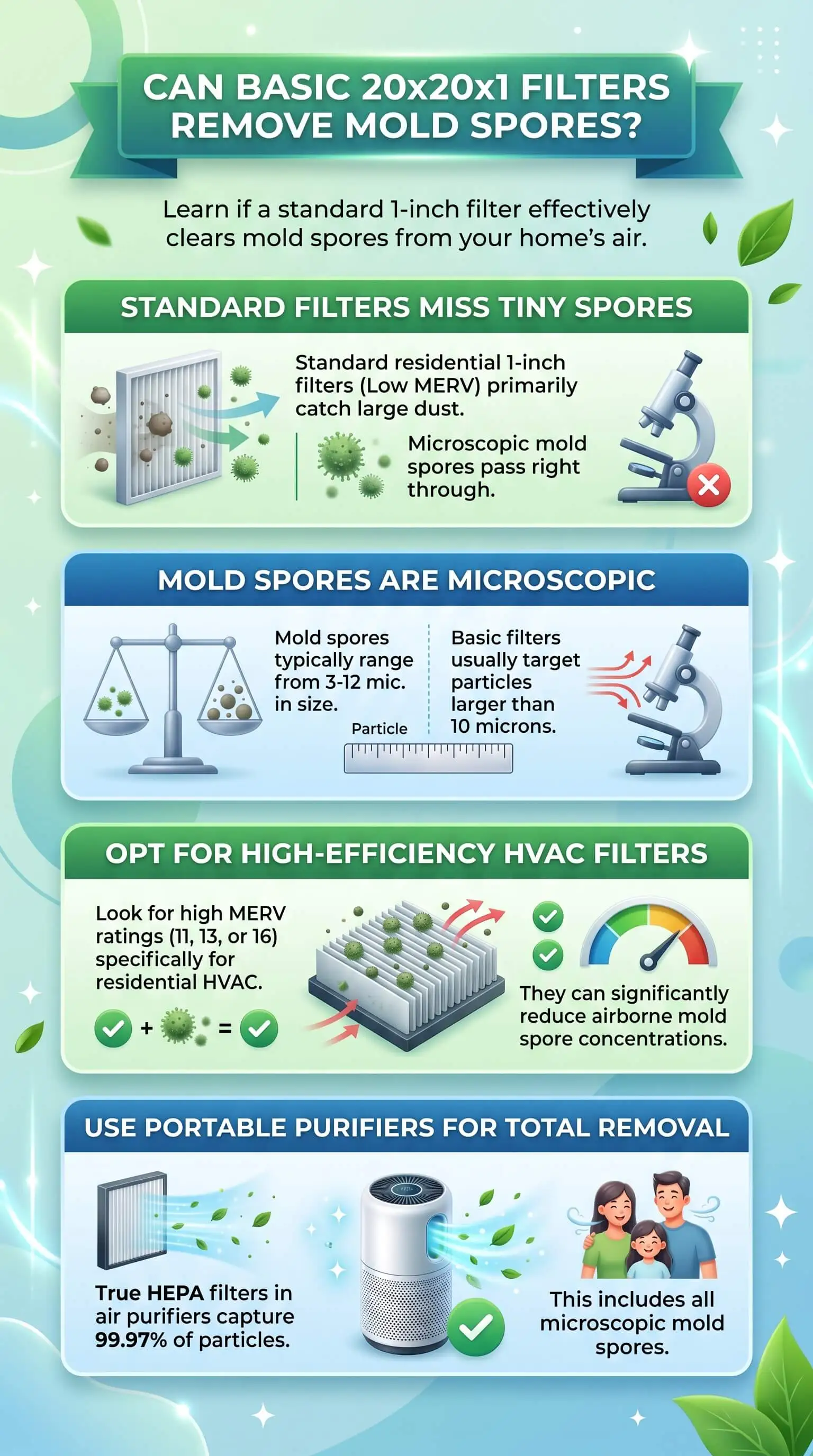
Size matters here. The three most common indoor mold genera (Cladosporium, Penicillium, and Aspergillus) produce spores that fall mostly in the 2 to 10 micron range. For context: a human hair runs about 70 microns across, so a spore is roughly one-tenth that diameter. Some species push smaller or larger, but the bulk of what an HVAC filter handles sits squarely in the size range that MERV ratings actually measure.
That particle-size detail is the whole reason filter rating matters more than filter size for spore capture. The 20x20x1 cabinet sets the physical footprint. The media inside that footprint determines whether the spores get through.
How a 20x20x1 Filter Captures Spores (The MERV Question)
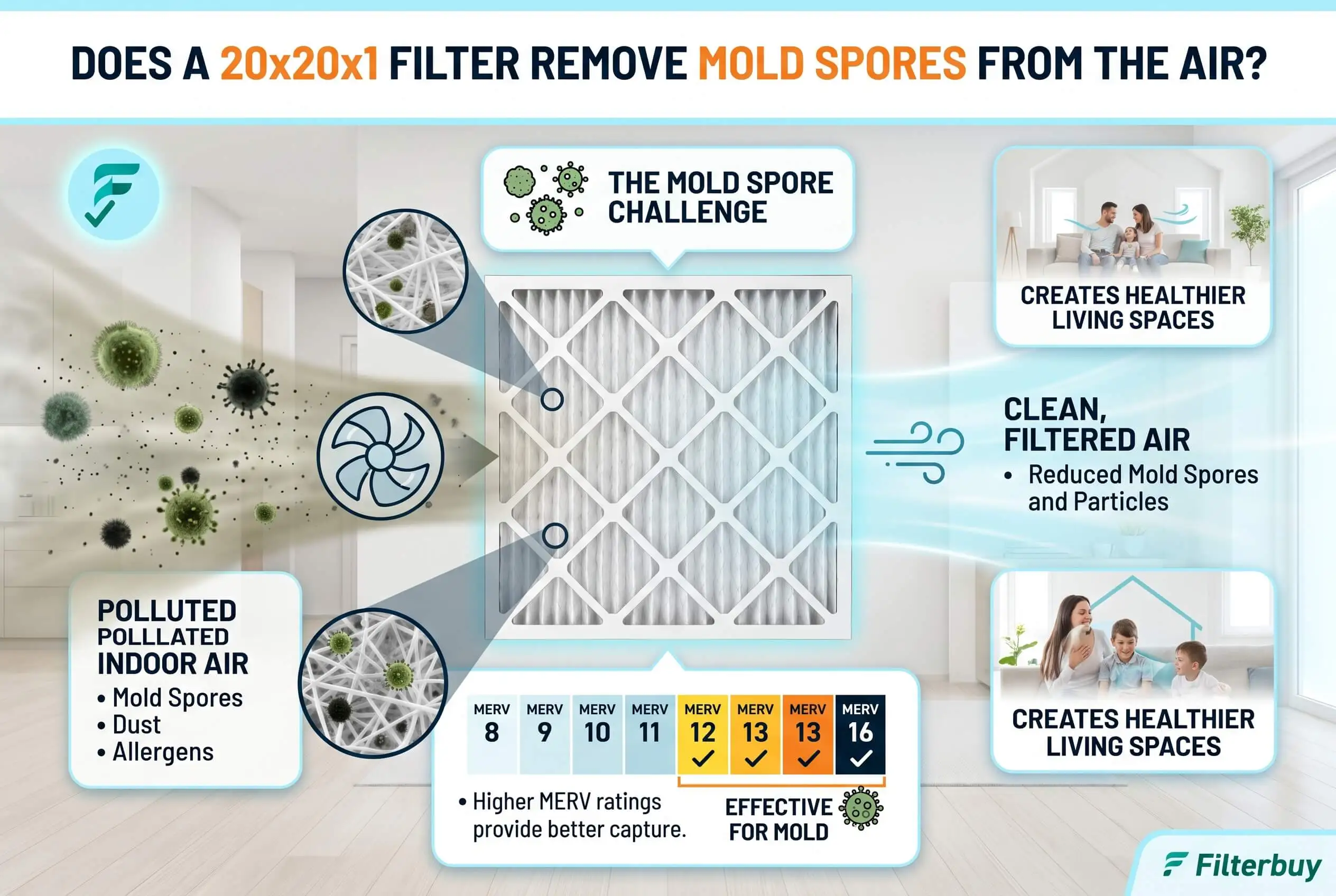
MERV stands for Minimum Efficiency Reporting Value. The ASHRAE 52.2 standard sets the test method, which measures how well an air filter captures particles between 0.3 and 10 microns. ASHRAE splits that range into three size groups (E1 at 0.3 to 1.0 microns, E2 at 1.0 to 3.0 microns, and E3 at 3.0 to 10.0 microns) and reports the lowest capture efficiency the filter posts in each group. E3 is where most mold spores live.
For a 20x20x1 in residential service, the practical tier breakdown is straightforward.
MERV 8 captures roughly 20 to 35 percent of E3 (3 to 10 micron) particles. It catches some spores and misses many of the smaller ones.
MERV 11 captures 65 to 80 percent of E2 (1 to 3 micron) particles and a higher share of E3. This is the tier where spore-targeted filtration starts doing real work.
MERV 13 captures 90 percent or more of E2 particles and effectively all of E3. It is the residential ceiling for spore capture in a 1-inch cabinet.
When homeowners ask us which MERV to put in a 20x20x1 cabinet to deal with spores, we point them to a MERV 11 or MERV 13 20x20x1 air filter. The MERV 8 standard simply isn't built for that job. For readers who want the underlying physics, Wikipedia's air filter article walks through how pleated media actually captures particles (interception, impaction, and diffusion).
Replacement Cadence When Spore Load Is High
Most retail boxes print a 90-day replacement interval on the side of a 1-inch filter. That number assumes baseline residential dust loading and no special conditions. When mold is in the picture, the cadence shortens.
In our experience helping homeowners through post-flood remediation or stretches of persistent humidity, we tell people to drop the interval to 30 to 60 days for as long as the underlying conditions stick around. A few reasons why.
Higher MERV media loads faster. A MERV 13 pleat picks up visible debris weeks before a MERV 8 in the same household.
The organic material a filter captures is humidity-sensitive. Leave a loaded filter in a humid system for an extra month and the filter face itself can grow surface mold.
Pressure drop rises as the filter loads. A clogged high-MERV filter starves the air handler, reduces airflow across the coil, and in extreme cases freezes the coil outright. None of that helps the IAQ goal.
The replacement signal is on the filter, not on the calendar. Three things to look for: visible discoloration on the return-side face, a musty odor when the system kicks on, or a noticeable drop in supply airflow. Any one of those means swap the filter, regardless of how many days have passed.
What a 20x20x1 Filter Cannot Fix
Most filter content skips this part, and it's the part that matters most. A filter only captures spores that are already airborne. It does nothing about the mold growing on a wet ceiling tile, on the back of a vinyl wallcovering, inside a wall cavity behind a slow plumbing leak, or on the cooling coil of an HVAC system that has been condensing humidity onto a fouled surface for a year.
The EPA is direct about this: mold control is moisture control. A spore that lands on a dry surface stays dormant. A spore that lands on a surface wet enough for long enough germinates, and once that happens you have a colony releasing more spores into the air than any filter on the market can outrun.
One scenario warrants special handling, and EPA spells it out clearly. When you suspect mold growth inside the HVAC system itself, do not run the system. Running it spreads spores throughout the building. Shut the system down and bring in an inspector before you put any filter back in. Once the system is safe to use again, top air filters can help support cleaner, healthier airflow moving forward.
CDC sets the upstream threshold at indoor relative humidity below 50 percent, year-round. Filtration sits below that line in the priority stack.
“After years walking through homes with this exact concern, the pattern is unmistakable: every house where filtration alone solved a mold problem was a house that never really had a moisture problem to begin with. A MERV 13 filter does real work on what's already airborne, but the actual fix almost always lives upstream of the return grille.”
7 Essential Resources
The primary sources below are the ones we point homeowners to first when a mold question turns serious. All are .gov publications maintained by federal agencies.
EPA, A Brief Guide to Mold, Moisture, and Your Home. The single best consumer-facing starting point for anyone working through a residential mold concern. epa.gov/mold/brief-guide-mold-moisture-and-your-home
EPA, What is a HEPA filter? Includes the clearest plain-language definition of MERV and the 0.3 to 10 micron test range. epa.gov/indoor-air-quality-iaq/what-hepa-filter
EPA, Guide to Air Cleaners in the Home. Covers both portable air cleaners and central HVAC filtration, with strategy guidance on when each makes sense. epa.gov/indoor-air-quality-iaq/guide-air-cleaners-home
EPA, Mold Cleanup in Your Home. Practical thresholds (10 square feet) and the explicit guidance on shutting down a contaminated HVAC system. epa.gov/mold/mold-cleanup-your-home
CDC, Basic Facts about Mold and Dampness. The source for the under-50-percent indoor humidity benchmark and a balanced view of mold-related health effects. cdc.gov/mold-health/about
CDC NIOSH, Mold Health Problems. Workplace-focused but directly applicable to homes where asthma or hypersensitivity pneumonitis are concerns. cdc.gov/niosh/mold/health-problems
OSHA, A Brief Guide to Mold in the Workplace. Useful for understanding what mold remediation actually looks like at a professional standard, even in a residential context. osha.gov/publications/shib101003
3 Statistics
Americans spend roughly 90 percent of their time indoors, where some pollutant concentrations run 2 to 5 times higher than typical outdoor levels. That's why airborne spore exposure happens almost entirely inside the conditioned envelope. Source: EPA Report on the Environment: Indoor Air Quality
Indoor relative humidity should stay below 50 percent to prevent mold growth. CDC sets this as the upstream threshold that decides whether spores landing on indoor surfaces germinate or stay dormant. Source: CDC: Basic Facts about Mold and Dampness
ASHRAE 52.2 tests MERV-rated filters for particle capture between 0.3 and 10 microns. HEPA-class filters remove at least 99.97 percent of particles at the 0.3 micron worst-case size. Mold spores typically run 2 to 10 microns, which puts them squarely inside MERV's measured range. Source: EPA: What is a HEPA filter?
Final Thoughts and Opinion
A 20x20x1 filter earns a useful spot on the defense team against airborne mold spores, and at MERV 11 or MERV 13 it does measurably more than at MERV 8. That's the practical conclusion. Our opinion, after working with homeowners on this exact question for years, is straightforward. Filtration deserves a place in any mold-reduction plan, but it should not be the only place to put effort or money. The dehumidifier matters more than the filter. A fixed plumbing leak matters more than either of those. Handle the upstream pieces first, and a properly rated, regularly changed 20x20x1 filter will quietly do its job in the background. That's exactly what good filtration is supposed to do.
Frequently Asked Questions
What MERV rating is best for capturing mold spores?
MERV 13 is the residential ceiling and captures 90 percent or more of particles in the 1 to 3 micron range, where most spores live. MERV 11 is the workable step down for any system that can't handle MERV 13's pressure drop. MERV 8 catches some spores but misses too many to be the right choice when mold is a stated concern.
How often should I change a 20x20x1 filter if I think I have mold?
Drop from the default 90-day cadence to 30 to 60 days for as long as the underlying conditions stick around. Higher-MERV media loads faster, and a loaded filter in a humid system can grow surface mold on captured organic debris. Visible discoloration, musty odor, or noticeable airflow loss are the swap signals to watch.
Can a regular 20x20x1 filter kill mold?
No. A standard filter is a mechanical capture device, not a biocide. It traps spores on the media surface and holds them there until you remove the filter. Some specialty filters carry antimicrobial coatings, but for residential mold concerns the better strategy is shorter replacement intervals on a quality MERV 11 or MERV 13 filter.
Will a higher-MERV 20x20x1 filter damage my HVAC system?
Most residential systems built in the last 20 years handle MERV 11 without issue, and many handle MERV 13. The risk shows up in systems originally spec'd for low-resistance filtration when someone suddenly drops in a higher-MERV filter. If you're unsure, check your blower's static pressure tolerance or have an HVAC technician confirm before upgrading.
Should I run my HVAC system if I suspect mold inside it?
EPA guidance is no. Running an HVAC system with suspected internal mold contamination spreads spores throughout the building, undermining the air quality you're trying to protect. Shut the system down, get an inspection, and address the contamination at the source before resuming normal operation. Once the system is safe to run again, replace the old filter with the right Bryant air filters for your unit to help support cleaner airflow going forward.
Ready to Match a 20x20x1 Filter to a Mold Concern?
The filtration layer of any spore plan starts with a MERV 8 filter in the 20x20x1 size. Pair it with the moisture fix upstream and a shorter replacement cadence, and the filter will quietly hold up its end of the work.