The cleanest air Rochester gets all year shows up in May. The dirtiest arrives around four o’clock on a July afternoon, which is exactly when most of us are outside enjoying it.
That backwards feeling is why this page exists. I’ve spent years crawling through attics and mechanical rooms across Monroe County, and I keep meeting homeowners who’ve built their outdoor lives around the one season quietly working against them. Pleated furnace filters can help manage the particles that make their way indoors during those stretches. Bright sky, warm air, rough reading on the monitor.
So here’s the year, month by month, with the pollutants driving each stretch and what to do indoors when the number outside heads the wrong way. You can’t see a bit of it happening. That’s what makes it worth knowing.
TL;DR Quick Answers
Air Quality Rochester NY
Rochester NY air quality rates Good on most days of the year, and the metro holds passing grades on all three federal pollution measures. What changes here is the season, not the city.
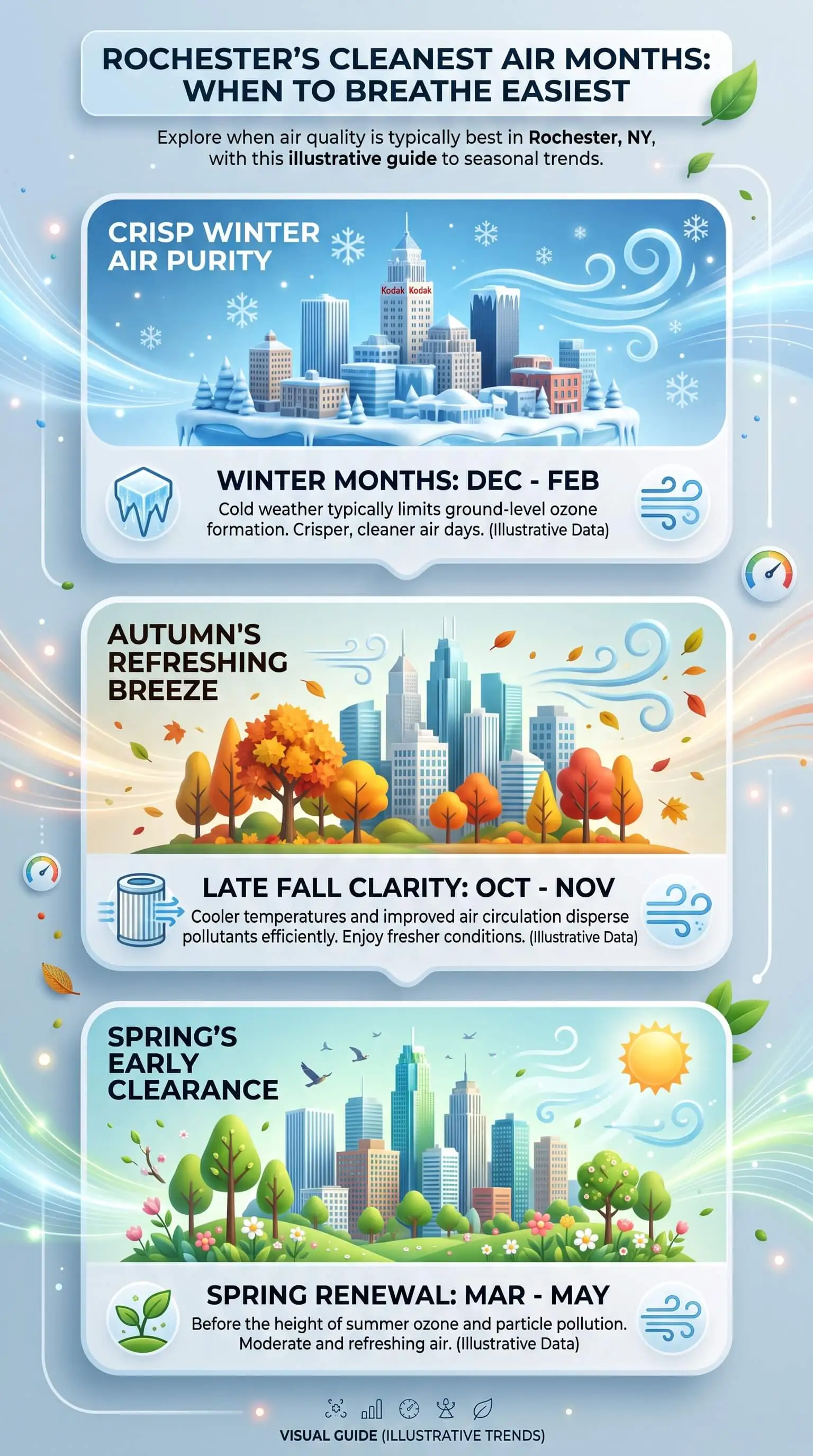
Cleanest months: May and April, with October close behind.
Worst stretch: July and August afternoons, driven by ground-level ozone.
Winter concern: fine particles trapped by cold-morning inversions, not ozone.
Best time of day in summer: before noon, before ozone builds.
Pollen: never counted in the AQI, so a clean reading doesn't promise a clean allergy day.
What the live trackers won't tell you: the dominant pollutant matters more than the headline number, because it decides whether filtration helps at all. Particles answer to a MERV 13 filter or real HEPA media. Ozone ignores both, since a gas slips through anything without a serious carbon bed.
Top Takeaways
April, May, September and October deliver Rochester’s cleanest and most dependable air.
Summer afternoons are the yearly low point, and ground-level ozone is the reason, not particles.
Cold, still winter mornings trap fine particles at street level until the inversion breaks.
The dominant pollutant matters more than the headline number, because it decides whether filtration can help you at all.
The AQI doesn’t measure pollen, so a good reading and a miserable allergy day can absolutely happen together.
Why Rochester’s Air Changes So Much From One Month to the Next
Rochester sits on the south shore of Lake Ontario at the mouth of the Genesee River, and that address explains most of what follows. The city’s geography and climate swing hard between seasons, and the air swings right along with them.
Three forces take turns here. Lake breezes and strong vertical mixing scrub the air clean through spring and early fall. Heat and sunlight cook nitrogen oxides and volatile organic compounds into ground-level ozone all summer. Then winter arrives, cold air settles, and an inversion drops a lid over the city that pins furnace exhaust and traffic emissions at street level until the sun or a front breaks it open.
A fourth force has muscled in over the past few years, and it doesn’t start here at all. Smoke. We sit downwind of an awful lot of continent, and a bad fire season a thousand miles away can wreck an otherwise perfect local air day.
Rochester Air Quality Month by Month
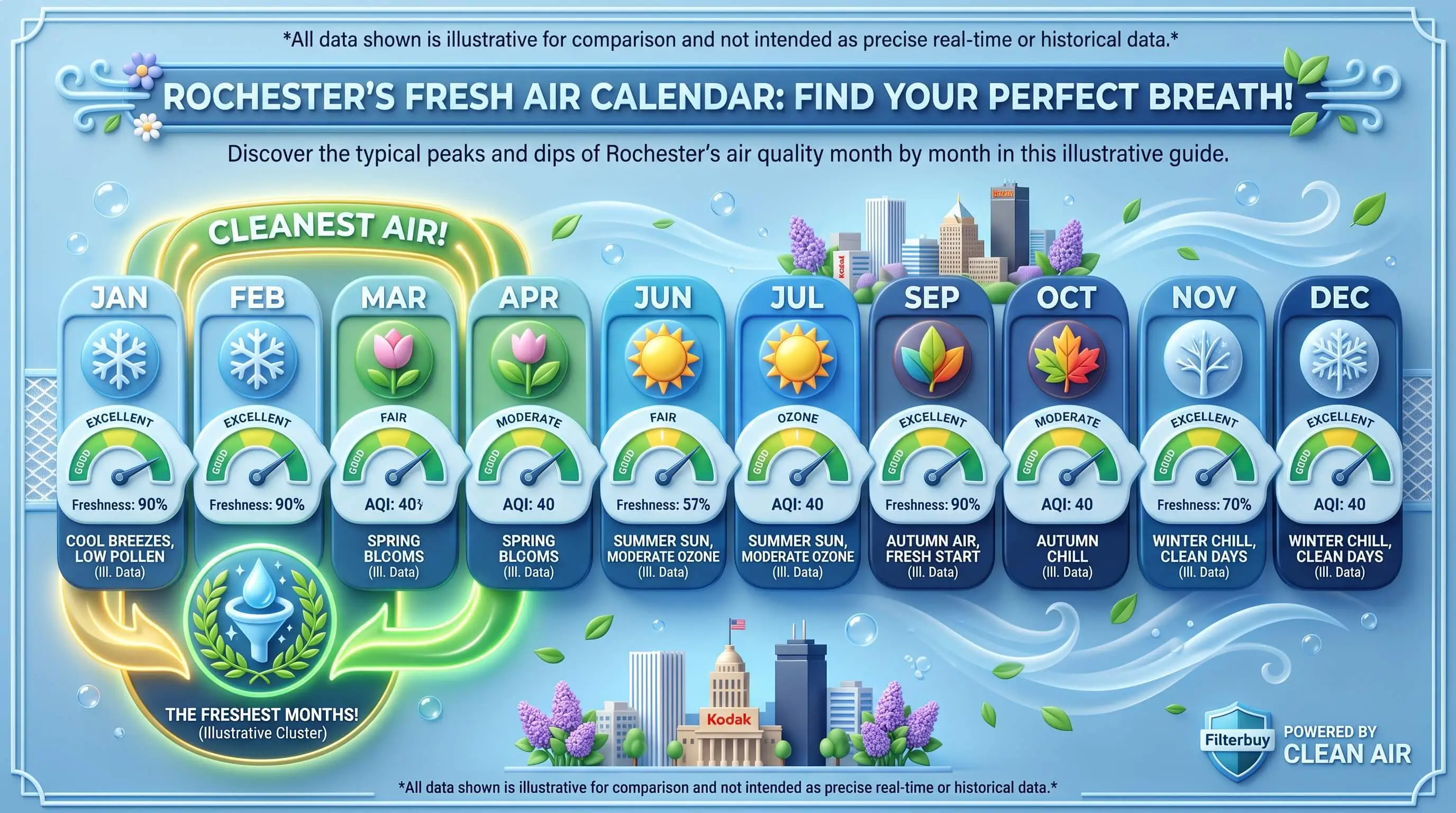
January Through March: Particle Season
Ozone bottoms out in deep winter, so the whole story is fine particles. On a still, cold morning the air near the ground quits mixing with the air above it, and everything we generate down here stays down here, from furnace exhaust to wood smoke to whatever the commute leaves behind. I’ve pulled up to January job sites where you could smell the neighborhood before getting out of the truck. Things loosen up by afternoon once the sun stirs the column, or immediately when a front rolls through.
April and May: The Cleanest Window of the Year
This is Rochester at its best. Mild temperatures, freely moving air, and ozone chemistry that hasn’t switched on yet, while heating loads fall away at the same time so the particle sources fade right alongside them. Take May. If you’re picking one month to run outside every morning that’s the one, and the state backs up the timing by running daily ozone forecasts from April through September.
June Through August: Ozone Peak
Summer looks like the safe season, and it’s actually the dirtiest stretch on the calendar. Long days of heat and sunlight drive ozone formation, with the peak landing in late afternoon and early evening. A July morning can read beautifully while four o’clock that same day reads nothing like it. Summer is also when smoke transport is likeliest, stacking a particle problem on top of the ozone problem you already had.
September and October: The Second Clean Window
Temperatures drop, sunlight weakens, ozone production winds down, and the heating season hasn’t started. Early September can still carry smoke, so it’s less dependable than spring. By mid-October the air runs about as good as it gets here, and this is my favorite window for throwing the windows open and flushing a house out before winter seals it up.
November and December: Inversions Return
Furnaces run longer, wood stoves come back, and those cold-morning inversions start showing up again. Nothing dramatic happens. The drift just runs the wrong direction, and it holds until spring.
The Two Cleanest Windows, and How I Actually Use Them
A monthly average hides the thing that matters most, which is the clock. Even in the worst month, Rochester mornings are usually fine. And even in the best one, a hot, stagnant afternoon can hand you a reading you’d rather have avoided.
So I treat the calendar and the clock as two separate decisions. April, May, September and October get a glance. June, July and August get a real check, and anything strenuous goes before noon. December through February I flip it, because afternoons beat early mornings once the inversion breaks.
Pollen Isn’t in the AQI
This causes more confusion than anything else I get asked about. The Air Quality Index tracks ozone, particles, carbon monoxide, nitrogen dioxide and sulfur dioxide. Pollen isn’t on the list. A May morning can read Good on every monitor in the county and still leave you miserable, because tree pollen is doing the damage and the index never saw it.
If your symptoms and the AQI keep disagreeing, that’s almost always why. Pull a pollen count alongside the air quality number instead of assuming one explains the other.
What a Tight Building Envelope Does With Dirty Outdoor Air
Here’s where my day job runs straight into this topic. A well-sealed, well-insulated house is a genuine advantage on a smoke day or a high-ozone afternoon, because far less outdoor air is sneaking in uninvited. I’ve measured the gap between a tight house and a leaky one during a smoke event, and it isn’t subtle.
The catch is that a tighter envelope concentrates whatever you generate indoors, whether that’s cooking particles, candle soot, or what causes dust to build up from a vacuum without decent filtration. Sealing a house doesn’t clean its air. It changes which air you’re breathing, and it puts far more weight on your filter and your ventilation habits.
How I Check Rochester Air Before Planning Outdoor Work
My routine takes about fifteen seconds. I pull up the live air quality index map for Rochester, and then I do the part almost everybody skips. I look past the headline number to find the dominant pollutant. That one detail decides what you should do next.
If particles are running the show, filtration works. A MERV 13 filter in the system, or a portable unit with real HEPA media, will pull that load down in a way you can measure. Ozone is a different animal. HEPA media captures particles, and ozone is a gas, so it passes straight through. Stripping it out takes a serious activated carbon bed, and most consumer purifiers don’t have one. On a high-ozone afternoon, the honest answer is to close up and wait it out rather than buy a machine that can’t do the job.
Rochester sits inside the state’s Eastern Lake Ontario advisory region alongside Monroe, Wayne, Oswego, Jefferson and northern Cayuga counties. Advisories cover that whole region at once, so an alert with Rochester’s name on it may be driven entirely by conditions well outside the city. MERV 8 pleated HVAC furnace air filters can still help capture many of the larger airborne particles that make their way indoors during those advisory periods.
“The mistake I run into most is somebody buying a purifier in July to fix an ozone problem, then wondering why nothing changed. Match the machine to the pollutant. Particles need media and gases need carbon. Skip that step and you’ve bought yourself a very expensive fan.”
7 Essential Resources
Every link below goes to a primary government source. These are the pages I keep bookmarked.
AirNow: Air Quality Index Basics: the six AQI categories and what each means for your plans, from the agency that built the scale.
NYSDEC: New York AQI Forecast and Current Observations: the state forecast, plus the county list showing who shares Rochester’s advisory region.
Monroe County: Air Quality Health Guidance: county recommendations by AQI band, including youth sports and outdoor work.
National Weather Service, Buffalo Office: the office forecasting for Rochester, with air quality, hazard and climate pages.
CDC: Wildfires and Your Safety: who faces higher risk from smoke, and what to do before, during and after.
NIEHS: Air Pollution and Your Health: research linking particles and ozone to respiratory, cardiovascular and neurological outcomes.
ENERGY STAR: Why Seal and Insulate: how envelope work changes the way outdoor air gets into your home at all.
3 Statistics
Our particle problem outranks our smog problem. In the American Lung Association’s 2026 State of the Air report, the Rochester, Batavia and Seneca Falls metro ranked 125th worst nationally for ozone but 89th worst for short-term particle pollution, with Monroe County carrying 2.2 unhealthy particle days a year and a D grade. American Lung Association
Most of your exposure happens indoors. The EPA reports that Americans spend roughly 90 percent of their time inside, where concentrations of some pollutants often run two to five times higher than typical outdoor levels. U.S. Environmental Protection Agency
Your walls leak more than you think. The Department of Energy puts air leakage at 30 percent or more of a home’s heating and cooling costs, which doubles as a measure of how much unfiltered outdoor air moves through the building. U.S. Department of Energy
Rochester’s air-quality pattern shows that short-term particle pollution, indoor exposure, and air leakage all matter, making HVAC maintenance an important part of managing filtration and the air moving through the home.
Final Thoughts and Opinion
If I had to compress years of watching this pattern into one sentence, it would be this. Rochester’s air is genuinely good most of the year, and the people who get caught out are the ones who assume summer is the safe season.
My honest opinion is that we underrate the winter particle story around here. Everybody knows about smoke summers now, because they were impossible to miss. Far fewer people think about the cold February morning when the air over their street simply stops moving. Smaller effect than a smoke event, no argument. But it repeats dozens of times a year, and it lands exactly when the house is sealed tight, high quality filters matter most, and the furnace is working hardest.
Enjoy April, May, September and October without a second thought. Check before you commit to a July afternoon. And don’t let a good annual average talk you out of paying attention on a still winter morning.
Frequently Asked Questions
What is the air quality in Rochester NY like overall?
Rochester’s air quality is good most of the year, and the metro earned passing grades across all three federal pollution measures in the most recent national report card. The trouble sits in specific windows rather than spreading evenly across the calendar, which makes a yearly average a poor planning tool.
Which month has the cleanest air in Rochester?
May is typically the cleanest month, with April right behind it. Mild temperatures and strong atmospheric mixing hold both ozone and fine particles down, and heating-season emissions have largely stopped by then.
When is Rochester air quality at its worst?
July afternoons are the yearly low point, when heat and sunlight push ground-level ozone to its seasonal peak. Late afternoon into early evening is the roughest part of those days, and mornings on the very same date are often perfectly fine.
Does wildfire smoke reach Rochester?
Yes, and it’s become a regular feature of the warm season. Smoke travels hundreds of miles, so a local air quality alert can be driven entirely by fires nowhere near New York State.
Does a HEPA filter remove ozone?
No. HEPA media captures particles, and ozone is a gas, so it goes right through. Removing ozone takes a substantial activated carbon bed, and most consumer air purifiers don’t include one in any meaningful quantity.
Does pollen affect the Rochester AQI?
No. The Air Quality Index measures ozone, particulate matter, carbon monoxide, nitrogen dioxide and sulfur dioxide, and pollen isn’t among them. Check a separate pollen count when your symptoms don’t match the air quality reading.
What to Do Next
Start with one habit this week. Between June and August, check the index before committing to anything strenuous outdoors, and find out which pollutant is in charge before deciding whether a filter helps or whether you just need to wait three hours.
Then look at your own house. If the envelope is tight, your filter is doing work that leaks used to do, so give it the attention it has earned. If the house is loose, outdoor air is showing up whether you invited it or not. Make duct cleaning a priority when built-up dust and debris inside the system are affecting the air moving through your home. Either way, you now know which months to relax about and which ones deserve a look. You decide what your family breathes indoors, and knowing the pattern is most of that battle.