TL;DR Quick Answers
Air Quality Washington DC
Washington DC's air quality is generally good most of the year, but it fails the national ozone standard every summer, and wildfire smoke can spike particle pollution between June and October. I check a live AQI reading before spending real time outside, especially during ozone season or when smoke is in the forecast.
Good most of the year, though DC fails the national ozone standard every summer
Wildfire smoke season runs June through October and can spike particle pollution fast
Check a live reading first before spending real time outside, especially in summer
Top Takeaways
DC's air quality is generally manageable, but it fails the national health standard for ozone during most summers
Two pollutants matter most here: ground-level ozone in summer, and fine particulate matter from wildfire smoke roughly June through October
Readings can vary block to block, since the District's six monitoring stations do not all show the same number at once
An AQI above 100 is the point where sensitive groups, including kids, older adults, pregnant residents, and anyone with asthma or heart disease, should scale back outdoor time
Checking a live reading before heading out takes less time than deciding what to wear
What the AQI Actually Measures
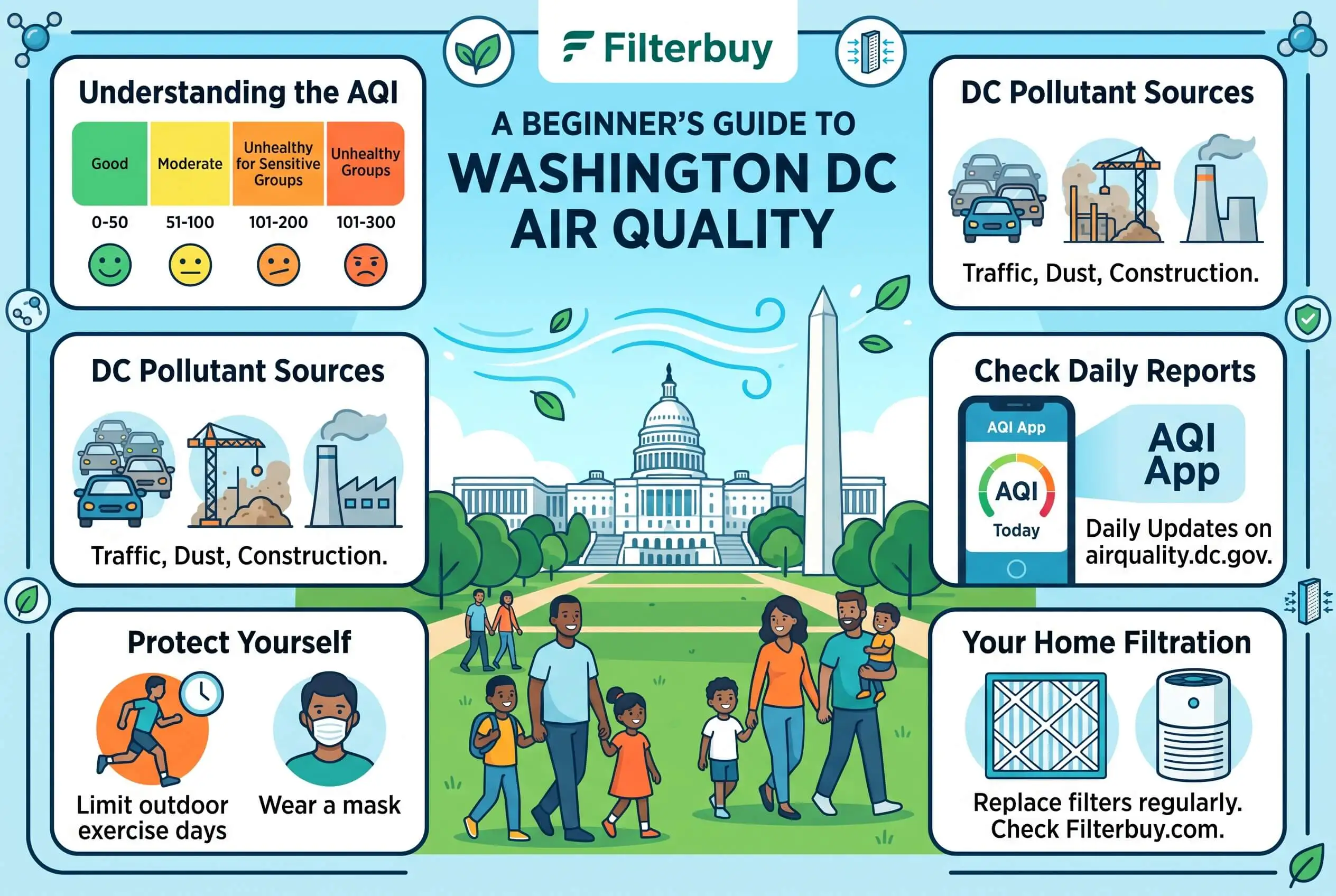
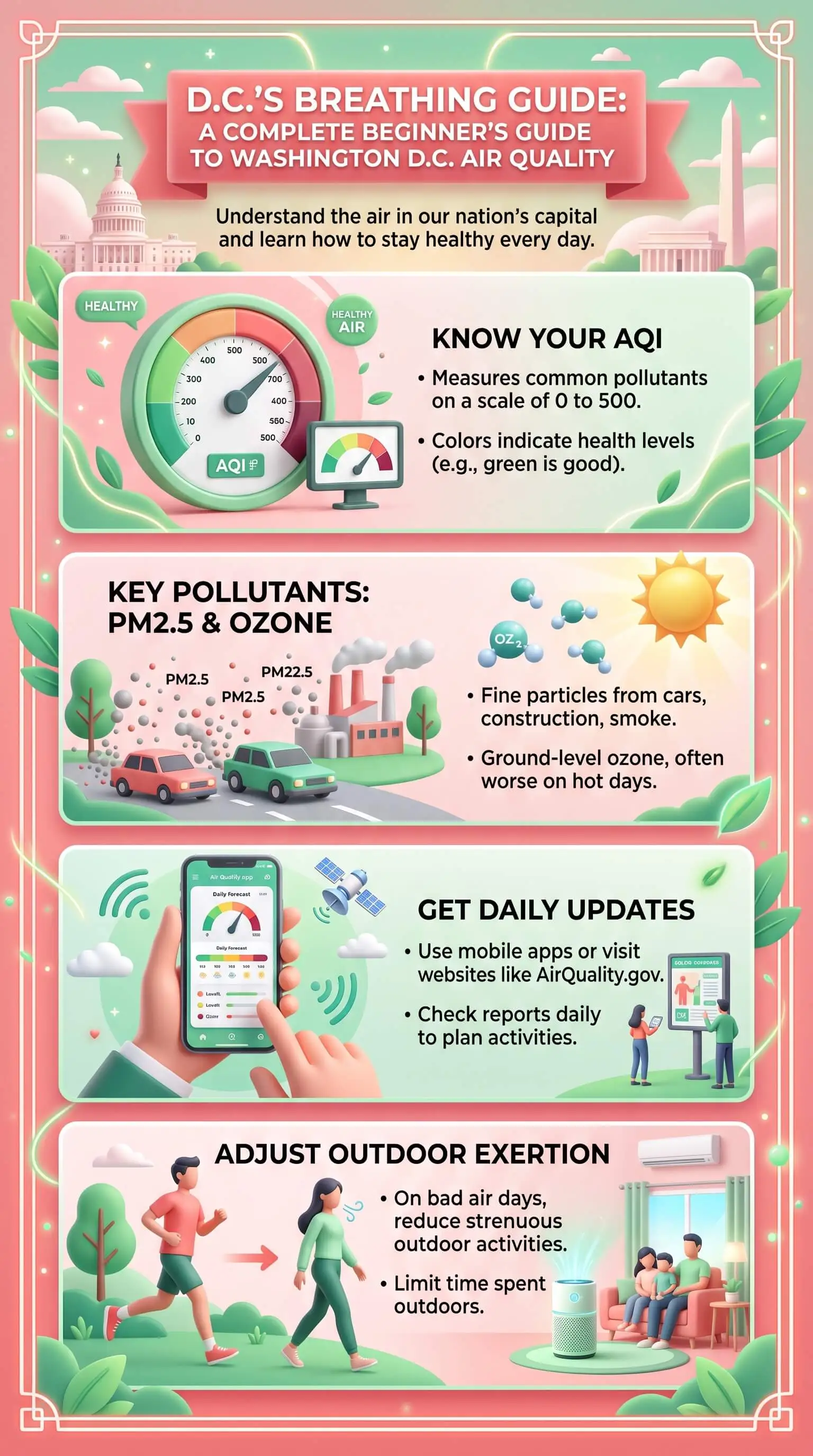
The Air Quality Index runs from 0 to 500 and translates pollution levels into six color-coded categories, from green (good) up through purple and maroon (hazardous). A reading of 50 or below counts as good air, and anything up to 100 is still acceptable for most people. Once the number climbs past 100, people with asthma, heart conditions, or other sensitivities should start scaling back outdoor exertion, and past 150, that caution applies to everyone outside. In DC, the AQI is driven almost entirely by two pollutants. Ground-level ozone forms on hot, sunny days when vehicle and industrial emissions react with sunlight. Fine particulate matter, tiny airborne particles, spikes sharply during wildfire smoke events. That's it. Two pollutants, most of the time. I use the color first, then the number, as my quick gut check before deciding how long to stay outside, and I rely on an air purifier indoors when outdoor conditions are less favorable.
Why DC's Air Quality Shifts Through the Year
DC's air does not stay the same from month to month. Ozone season runs roughly May through September, when long daylight hours and summer heat create ideal conditions for smog to build up over the city. The District regularly falls short of the national ozone health standard during those stretches, even though it meets the standard for most other regulated pollutants. Wildfire smoke season overlaps with ozone season and can stretch into October, carrying particle pollution in from fires burning hundreds of miles away. The District runs six official monitoring stations spread across different neighborhoods, and readings can vary block to block depending on wind, traffic, and elevation. When I want a live, neighborhood-level read on conditions before I plan my day, I check the live AQI map for the District instead of relying on a single citywide number.
Who Should Pay Closer Attention
Not everyone needs to track DC's air quality the same way. Kids, older adults, pregnant residents, and anyone with asthma, COPD, or cardiovascular disease feel the effects of poor air quality faster and more severely than a healthy adult does. For these groups, an AQI in the 100s is already a signal to shorten outdoor time or move activity indoors. Pairing outdoor AQI updates with indoor home air quality testing can also help determine whether the air inside your home remains healthy during higher pollution days. I don't fall into any of those groups myself, so my own threshold for changing plans is looser than it should be for someone who does. Everyone else generally has more room before conditions start to matter, but wildfire smoke events tend to close that gap quickly, since particle pollution can spike within a single afternoon even when the morning looks clear.
“After checking DC's AQI most summer mornings for years before heading outside, I have learned the number matters less than the trend. If it is climbing quickly by mid-morning, that is my cue to move errands indoors for the rest of the day.”
7 Essential Resources
1. AirNow.gov: Check the National AQI Scale Explained Simply
AirNow's AQI Basics guide breaks down what each AQI color and number actually means, straight from the source EPA uses to set the scale nationwide.
2. DC DOEE: See Where the District's Six Monitors Are Located
DOEE's ambient air quality monitoring page explains why the District's six stations sit where they do and how those readings feed into the national AirNow system.
3. CDC: Learn When Air Quality Actually Affects Your Health
This is the one I point people to first. CDC's About Air Quality overview walks through what to do at each AQI level, from early caution to full activity restrictions for sensitive groups.
4. Maryland MDE: Track the Regional Forecast, Not Just DC's
Maryland's air quality forecast page shows how DC, Maryland, and Virginia meteorologists coordinate one shared regional outlook instead of three separate ones.
5. NOAA: Follow Wildfire Smoke Forecasts Before They Arrive
NOAA's wildfire smoke and air quality overview explains how satellite data and weather models combine to predict where smoke will travel next, often days in advance.
6. Virginia DEQ: See the Full DC Metro Picture
Virginia DEQ's current air quality and forecast page covers the DC metro area directly and points to shared regional alert tools rather than treating Virginia's air as separate from the District's.
7. NIEHS: Understand the Research Behind the Health Warnings
I read this one when I wanted the actual science behind the health warnings, not just the warnings themselves. NIEHS's Air Pollution and Your Health summary reviews decades of research connecting short-term air pollution spikes to reduced lung function, asthma flares, and increased emergency room visits.
These trusted resources help you monitor Washington, DC's air quality, understand health risks, and make informed decisions, while pairing that knowledge with insulation installation can help reduce the amount of outdoor pollutants that enter your home.
3 Statistics
The American Lung Association's latest State of the Air ozone findings list Washington, DC among the jurisdictions that earned a failing grade for ozone pollution, alongside 36 states, based on monitoring data from 2022 through 2024.
The EPA's current national health standard for ozone is set at 70 parts per billion averaged over an eight-hour period. That number is the benchmark regulators use to decide whether a summer day in DC counts as unhealthy air.
According to DC Health Matters data on adult asthma, current asthma prevalence among DC adults ranges from roughly 8.7 percent to 17.2 percent depending on the ward, with a citywide median near 11 percent. That range is exactly why sensitive groups get told to watch the AQI closely.
With ozone pollution remaining a concern in Washington, DC and asthma affecting many residents, monitoring the AQI and using a MERV 8 pleated HVAC air filter can help support healthier indoor air when outdoor pollution levels rise.
Final Thoughts and Opinion
While I don't worry about Washington DC's air quality every day, checking it has become a small habit that has made a real difference for me. Ozone is a seasonal problem I can plan around. Wildfire smoke is not, and that is the one that catches people off guard. Neither takes more than thirty seconds of attention once it becomes routine, which is honestly the whole trick. Pairing that habit with a high quality filter at home can also help reduce exposure to outdoor pollutants that make their way indoors. My honest opinion: DC's air problem is overstated online and understated by people who ignore it completely. The truth sits somewhere in between, and checking daily is what gets you there.
Frequently Asked Questions
Is Washington DC's air quality bad?
Compared with much of the country, DC generally has good air quality, but it consistently falls short of the national health standard for ground-level ozone during summer months, and wildfire smoke can push particle pollution to unhealthy levels for days at a time.
What is a good AQI number for DC?
Anything at or below 50 counts as good. Between 51 and 100, air quality is still acceptable for most people, though sensitive groups may notice mild effects. Above 100 is the point where checking daily starts to matter.
When is DC air quality the worst during the year?
Ozone typically peaks on hot, sunny days between May and September, while wildfire smoke can spike particle pollution any time between June and October depending on fire activity elsewhere in North America.
How do I check DC's air quality every day?
I check a live AQI reading first thing, since DC's six monitoring stations can show different numbers depending on the neighborhood, then glance at the color-coded scale to decide what to do outside and whether it's a good day to rely on my HVAC system to help maintain cleaner indoor air.
Does wildfire smoke affect Washington DC?
Yes. Smoke from fires burning in Canada or the western United States regularly drifts into the DC area and can raise particle pollution sharply within hours, even when local sources of pollution stay low.
CTA
Knowing DC's air quality before I head out has become as automatic as checking the weather, and it takes about the same amount of time. The live AQI map I mentioned above is the fastest way to get a current, neighborhood-level read before you make your own plans for the day. Keeping pleated furnace filters clean and replaced on schedule also helps maintain healthier indoor air once you're back home.